

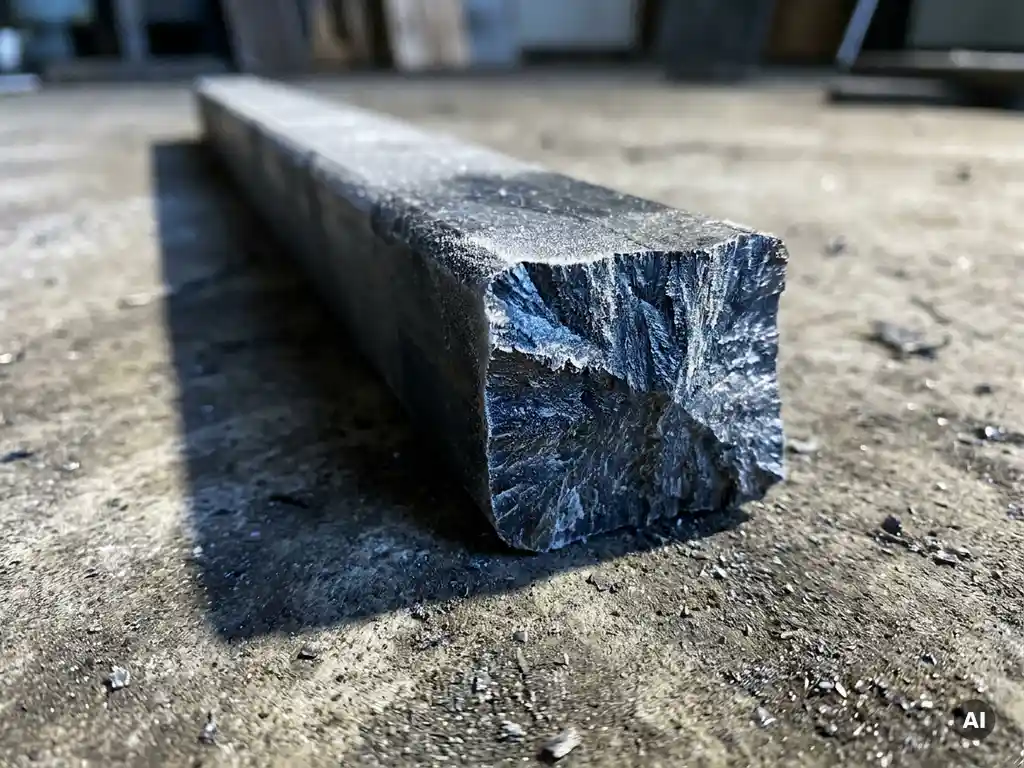
Phosphorus makes steel brittle at low temperatures because it segregates to grain boundaries during solidification, weakening the atomic bonds between steel’s crystalline grains. At reduced temperatures, this grain boundary weakening becomes critical: the steel loses its ability to deform plastically before fracturing, shifting from ductile to brittle failure. The sections below explain how this process works, which steels are most at risk, and how the industry manages phosphorus during production.
How does phosphorus get into steel in the first place?
Phosphorus enters steel primarily through the raw materials used in steelmaking, particularly iron ore, scrap steel, and pig iron. Iron ore naturally contains phosphorus compounds, and scrap metal collected from industrial or post-consumer sources can carry varying phosphorus levels depending on its origin and prior use. Once these materials are charged into the furnace, phosphorus dissolves into the molten steel and remains there unless actively removed during refining.
In basic oxygen furnaces and electric arc furnaces, phosphorus can be partially oxidized and transferred into the slag during the refining stage. However, this removal is not automatic. It requires careful control of slag chemistry, temperature, and oxidizing conditions. If those conditions are not well managed, a significant portion of the phosphorus stays in the melt and carries through to the final product.
Certain raw material sources are known to be higher in phosphorus than others. Steelmakers sourcing from these regions or using lower-grade scrap need to account for elevated phosphorus inputs from the start of the process, since removal becomes progressively harder as refining progresses.
What happens to phosphorus inside the steel microstructure?
Phosphorus is a substitutional solute in iron, meaning its atoms occupy positions within the iron crystal lattice. During solidification, phosphorus has a strong tendency to segregate: it migrates away from the solidifying crystal grains and concentrates at the grain boundaries, the interfaces between adjacent crystalline regions. This segregation is a thermodynamic process driven by the lower solubility of phosphorus in solid iron compared to liquid iron.
Once concentrated at grain boundaries, phosphorus atoms alter the local bonding environment. They reduce the cohesive energy at the grain boundary, meaning less force is required to separate one grain from another. In practical terms, this makes intergranular fracture, where cracks propagate along grain boundaries rather than through the grains themselves, significantly easier to initiate.
This weakening effect is not always obvious at room temperature or above, because the steel still has enough thermal energy and plasticity to redistribute stress. But as temperature drops, the consequences become severe, which leads directly to the phenomenon of low-temperature embrittlement.
Why does cold temperature make phosphorus embrittlement worse?
At low temperatures, the mobility of dislocations within steel’s crystal structure decreases sharply. Dislocations are the microscopic defects that allow metal to deform plastically rather than fracture. When dislocation movement is restricted by cold, the steel can no longer absorb impact energy through plastic deformation, so it fractures instead. Phosphorus at grain boundaries amplifies this effect by providing pre-weakened fracture paths that cracks can follow with very little energy.
The result is a pronounced drop in impact toughness, measurable through Charpy or Izod impact testing. Steel that performs acceptably at room temperature may fail in a brittle manner at temperatures well above freezing if phosphorus content is elevated. The temperature at which a steel transitions from ductile to brittle behavior is called the ductile-to-brittle transition temperature, or DBTT. Higher phosphorus content raises this transition temperature, meaning the steel becomes brittle under warmer conditions than it otherwise would.
This is why phosphorus embrittlement is particularly relevant for structural applications in cold climates, offshore environments, or any service condition where steel must absorb impact or dynamic loads at low temperatures. The risk is not theoretical: historical structural failures have been linked in part to elevated phosphorus content combined with low operating temperatures.
What steel grades are most vulnerable to phosphorus embrittlement?
High-strength low-alloy steels, pressure vessel steels, pipeline steels, and structural steels intended for low-temperature service are among the grades most sensitive to phosphorus embrittlement. These applications demand reliable toughness across a wide temperature range, and any grain boundary weakening from phosphorus directly undermines that requirement.
Carbon steels with higher carbon content tend to be somewhat more susceptible because carbon also contributes to grain boundary embrittlement mechanisms. Alloy steels containing manganese, nickel, or chromium can be more or less sensitive depending on how those elements interact with phosphorus at the grain boundaries. Some alloying elements compete with phosphorus for grain boundary sites and can partially mitigate its effect, while others may compound it.
Steels destined for Arctic pipelines, liquefied natural gas infrastructure, bridge construction in cold regions, and heavy-lifting equipment are subject to strict phosphorus limits precisely because of this vulnerability. In these sectors, phosphorus content is not just a quality parameter but a safety-critical specification.
How do steelmakers control phosphorus levels during production?
Phosphorus control begins with raw material selection and extends through every stage of the steelmaking process. The primary removal mechanism is oxidation: phosphorus is oxidized in the furnace and transferred to the slag as phosphate compounds. For this to work effectively, the slag must be sufficiently basic, meaning it must contain adequate lime, and the bath temperature must be controlled carefully, since phosphorus reoxidation from slag back into the steel becomes more likely at very high temperatures.
In basic oxygen steelmaking, a significant portion of phosphorus can be removed during the main blow if slag chemistry is well managed. In electric arc furnace operations, phosphorus removal is more challenging because the process relies heavily on scrap, which may carry variable phosphorus loads, and the thermal profile differs from oxygen furnace practice.
Secondary metallurgy and ladle treatment play an important supporting role. While major phosphorus removal happens in the primary furnace, ladle metallurgy stations allow steelmakers to fine-tune chemistry and manage the risk of phosphorus reversion. Controlling the flow of steel from the ladle through reliable ladle slide gate systems is also relevant here: consistent, controlled tapping and casting help avoid turbulence and slag carryover that can reintroduce unwanted elements into the clean steel stream.
Continuous monitoring of slag basicity, temperature, and steel chemistry through sampling and process analytics allows operators to intervene before phosphorus levels exceed target specifications.
What phosphorus content is considered safe for structural steel?
For general structural steel, most international standards set a maximum phosphorus content of around 0.04 to 0.05 percent by weight. For higher-performance applications, particularly those involving low-temperature service or impact-critical design, limits are considerably tighter. Pipeline steels and offshore structural grades frequently specify phosphorus below 0.020 percent, and some demanding specifications call for levels below 0.015 percent or even lower.
These limits are not arbitrary. They reflect accumulated knowledge from material testing, failure analysis, and the practical experience of steelmakers and standards bodies over many decades. The lower the phosphorus content, the lower the ductile-to-brittle transition temperature, and the wider the safe operating window for the finished steel product.
It is worth noting that achieving very low phosphorus levels consistently requires tight process control throughout steelmaking and casting. Clean steel production, which aims to minimize all harmful tramp elements and non-metallic inclusions, treats phosphorus as one of several key parameters to manage from furnace to final product.
How KNÖLLINGER FLO-TEC supports clean steel production
Producing steel with reliably low phosphorus content depends on consistent process control at every stage, including the way steel flows from the ladle during tapping and casting. Turbulence, slag entrainment, and reoxidation during this phase can compromise the clean steel chemistry that the upstream refining process worked hard to achieve.
We at KNÖLLINGER FLO-TEC develop and manufacture ladle slide gate systems specifically designed to support clean steel production in steelworks. Our systems are built to give operators reliable, controlled flow from the ladle, reducing the risk of reoxidation and slag carryover that can affect final steel quality. Key features of our approach include:
- Slide gate systems compatible with inert-gas shielding to help limit contact between the steel stream and ambient oxygen
- Robust, enclosed designs that support operational safety and help contain steel in the event of a leak
- Compatibility with a range of patent-free refractory plate formats, giving steelworks flexibility in their refractory supply
- Customized solutions adapted to different ladle sizes and operating requirements, including both continuous casting and ingot casting applications
- Systems designed around the principle of simplicity and reliability, reducing maintenance complexity for plant teams
If you are evaluating your ladle flow control setup or looking for a partner with deep experience in metallurgical slide gate systems, we welcome the conversation. Visit our product overview to learn more about our systems, or contact our team directly to discuss your specific requirements.
Dieser Inhalt wurde mithilfe von KI erstellt und kann Fehler enthalten.