

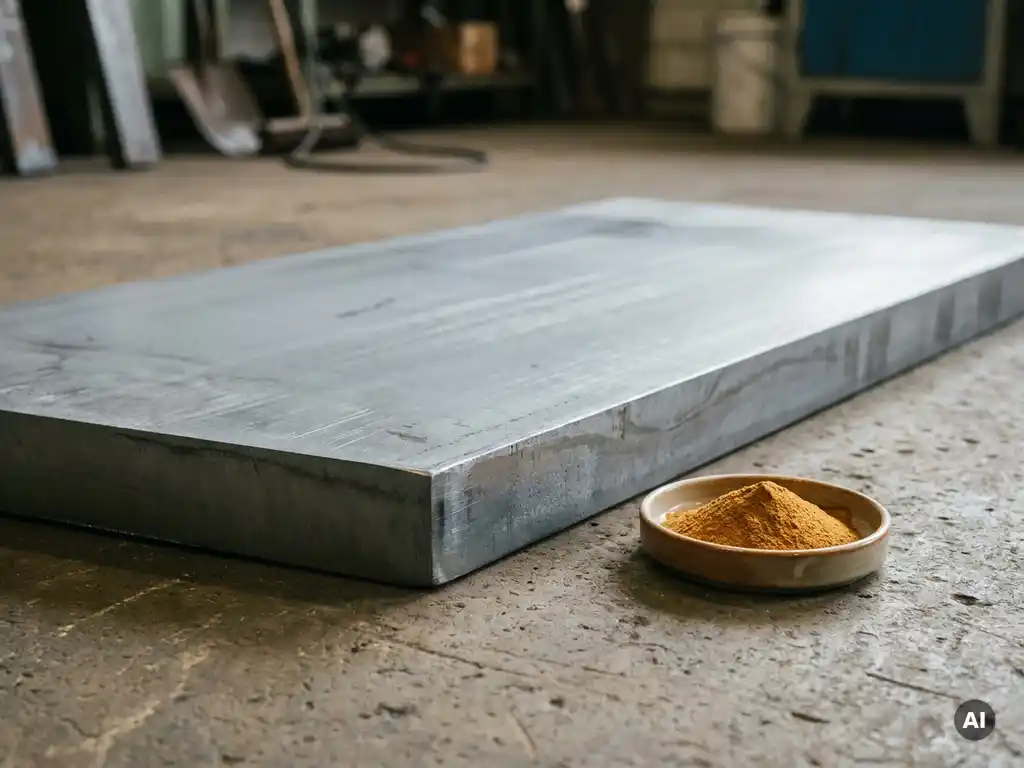
Mold powder composition directly affects surface quality in continuously cast slabs by controlling heat transfer, lubrication, and slag layer behavior between the molten steel and the copper mold. When the chemical balance of the flux is wrong, the result is uneven solidification, which leads to surface cracks, depressions, and inclusions that compromise slab integrity. The sections below break down exactly how each property of mold flux influences what happens at the steel-mold interface.
How does mold powder actually interact with molten steel during casting?
Mold powder melts on contact with the hot steel meniscus and forms a layered system: a sintered layer, a liquid slag layer, and a solid slag film that infiltrates the gap between the solidifying strand and the mold wall. This liquid flux continuously feeds into the gap as the strand moves downward, providing both lubrication and a controlled path for heat extraction.
The interaction starts the moment powder is added to the mold surface. The bottom layer melts and reacts with the steel, absorbing non-metallic inclusions that float up from the melt. This absorption function is one reason mold flux composition matters so much in clean steel production: a flux that cannot adequately absorb alumina or other oxide inclusions will leave them at the solidification front, where they become trapped in the slab surface.
The thickness and stability of the liquid slag pool are governed by the melting rate and viscosity of the powder, both of which depend on its chemical makeup. If the pool is too thin or unstable, lubrication breaks down intermittently, creating friction spikes that cause surface tearing.
Which chemical properties of mold flux control heat transfer to the mold?
The two chemical properties that most directly control heat transfer are basicity and crystallization tendency. Basicity, expressed as the ratio of CaO to SiO2, determines how readily the slag crystallizes as it cools. A more crystalline slag film scatters heat more effectively and slows heat extraction, while a glassy film allows faster, more uniform heat transfer to the mold wall.
For peritectic and near-peritectic steel grades, which are highly sensitive to uneven heat extraction, mold powders are typically formulated with a higher crystallization tendency. This deliberately reduces and evens out the heat flux, reducing the risk of surface depressions and longitudinal cracking that arise when the solidifying shell shrinks unevenly.
Other chemical components also play a role. Fluoride content influences both viscosity and crystallization behavior, while additions of Na2O, Li2O, or Al2O3 are used to fine-tune melting point and slag film properties. Each adjustment shifts the balance between lubrication and heat control, which is why mold flux selection is never a one-size-fits-all decision in continuous casting operations.
What surface defects are caused by incorrect mold powder composition?
Incorrect mold powder composition causes several distinct surface defects in continuously cast slabs, including longitudinal surface cracks, transverse cracks, surface depressions, oscillation mark irregularities, and entrapment of slag or inclusions just below the slab surface. Each defect type links back to a specific failure in flux behavior.
Longitudinal cracks and surface depressions
These defects typically result from uneven heat extraction. If the slag film crystallizes too slowly or not at all for a given steel grade, heat removal is too rapid and non-uniform. The solidifying shell develops thin spots that cannot withstand the ferrostatic pressure of the liquid steel core, causing local depressions or cracks that run parallel to the casting direction.
Transverse cracks and oscillation mark defects
Transverse cracking is often linked to inadequate lubrication during mold oscillation. When flux viscosity is too high for the casting speed and temperature, the liquid slag film thins out at the points of maximum friction, typically at the oscillation reversal points. The result is a stress concentration at the base of oscillation marks that can open into cracks during subsequent straightening of the strand.
Slag and inclusion entrapment
If the flux has insufficient capacity to absorb inclusions, or if turbulence at the meniscus causes flux droplets to be drawn into the steel, solid particles become trapped in the solidifying shell. These show up as slivers, blisters, or subsurface inclusions after rolling, and they are a direct quality risk for high-grade steel applications.
How does mold powder viscosity affect lubrication between strand and mold?
Mold powder viscosity controls how easily liquid slag infiltrates and maintains the lubrication film in the gap between the strand and the mold wall. Lower viscosity allows the slag to flow more freely into the gap at each oscillation cycle, while higher viscosity restricts flow and increases the risk of friction and sticking.
The right viscosity depends on casting speed. At higher casting speeds, the mold oscillates faster and the gap between strand and mold opens and closes more frequently. This requires a lower-viscosity flux to ensure the gap is reliably refilled with liquid slag at each cycle. Using a flux that is too viscous at high casting speeds leads to inadequate lubrication, increased friction, and a higher probability of breakouts or surface tearing.
Temperature also affects viscosity significantly. Because the slag film experiences a steep temperature gradient from the hot steel side to the cooler mold wall, viscosity varies across the film thickness. Flux formulators account for this by designing powders whose viscosity remains within an acceptable range across the relevant temperature window, rather than targeting a single value.
What’s the difference between mold powder for low-carbon and high-carbon steel grades?
The key difference is in basicity and crystallization behavior. Low-carbon and ultra-low-carbon steels, particularly those alloyed with aluminum, require mold powders with high basicity and a strong crystallization tendency to slow heat extraction and accommodate the large shrinkage these grades experience during solidification. High-carbon steels, by contrast, solidify more uniformly and tolerate faster heat extraction, so they use lower-basicity, more glassy flux formulations.
For aluminum-killed low-carbon grades, there is an additional complication: the flux must resist reacting with alumina inclusions in a way that destabilizes the slag composition. If the flux absorbs too much alumina, its viscosity and melting point shift, disrupting lubrication. This is why some low-carbon steel operations use powders with pre-added alumina or specially formulated CaO-Al2O3-based slags to maintain stability throughout the cast.
High-carbon grades, such as those used for wire rod or rail, present a different challenge. The peritectic transformation is less of a concern, but the flux must still provide adequate lubrication at the often lower casting speeds used for these grades. A slightly higher viscosity is acceptable, and the emphasis shifts toward consistent slag film formation rather than heat flux reduction.
How should mold flux be selected to minimize surface defects in slab casting?
Mold flux selection should be based on the specific steel grade being cast, the casting speed, the mold geometry, and the target surface quality. Start with the carbon equivalent and the solidification mode of the steel, then match basicity and crystallization tendency to the required heat extraction profile. From there, adjust viscosity to suit casting speed and mold oscillation parameters.
A structured selection process typically considers the following factors:
- Steel grade and carbon content: Determines the solidification behavior and the sensitivity to uneven heat extraction
- Casting speed: Sets the viscosity range required for reliable lubrication
- Mold width and taper: Influences the heat flux distribution and the risk of corner cracking
- Inclusion absorption requirements: Especially relevant for aluminum-killed and clean steel grades
- Melting rate of the powder: Must match the consumption rate to maintain a stable liquid slag pool
In practice, mold flux selection is an iterative process. Initial selection based on grade and speed parameters is followed by trial casts and surface inspection. Oscillation mark depth, slag rim formation, and any surface defects observed after rolling all provide feedback that guides further adjustment of the flux composition.
It is also worth noting that mold flux performance does not exist in isolation. Consistent steel cleanliness coming out of the ladle and stable flow control through the ladle slide gate system both influence what the mold flux has to deal with. Turbulent or inconsistent flow at the submerged entry nozzle can disrupt the slag pool regardless of how well the flux is formulated, so optimizing mold flux must go hand in hand with stable ladle-to-mold flow control.
How KNÖLLINGER FLO-TEC supports clean steel production in continuous casting
Mold flux performance depends heavily on what happens upstream. Stable, controlled flow from the ladle through the slide gate is a prerequisite for consistent slag pool behavior and reliable surface quality in the mold. Turbulence, flow fluctuations, or reoxidation at the ladle outlet all create conditions that even a well-chosen mold flux cannot fully compensate for.
This is where we at KNÖLLINGER FLO-TEC contribute directly to the quality chain. Our ladle slide gate systems are designed with clean steel production in mind, and they offer several relevant advantages for steelworks focused on slab surface quality:
- Inert-gas shielding capability to help reduce reoxidation between ladle and mold
- Reliable, stable flow control that supports consistent casting conditions and reduces meniscus turbulence
- Compatibility with different patent-free refractory plate formats, giving your team flexibility in refractory sourcing
- Robust construction suited to the demanding thermal and mechanical conditions of continuous casting operations
- Customized solutions for different ladle sizes and operational requirements
If you want to discuss how our slide gate systems can support your casting operation and contribute to better slab surface quality, get in touch with our team directly. We are happy to review your specific setup and identify where improvements are possible.
Dieser Inhalt wurde mithilfe von KI erstellt und kann Fehler enthalten.