

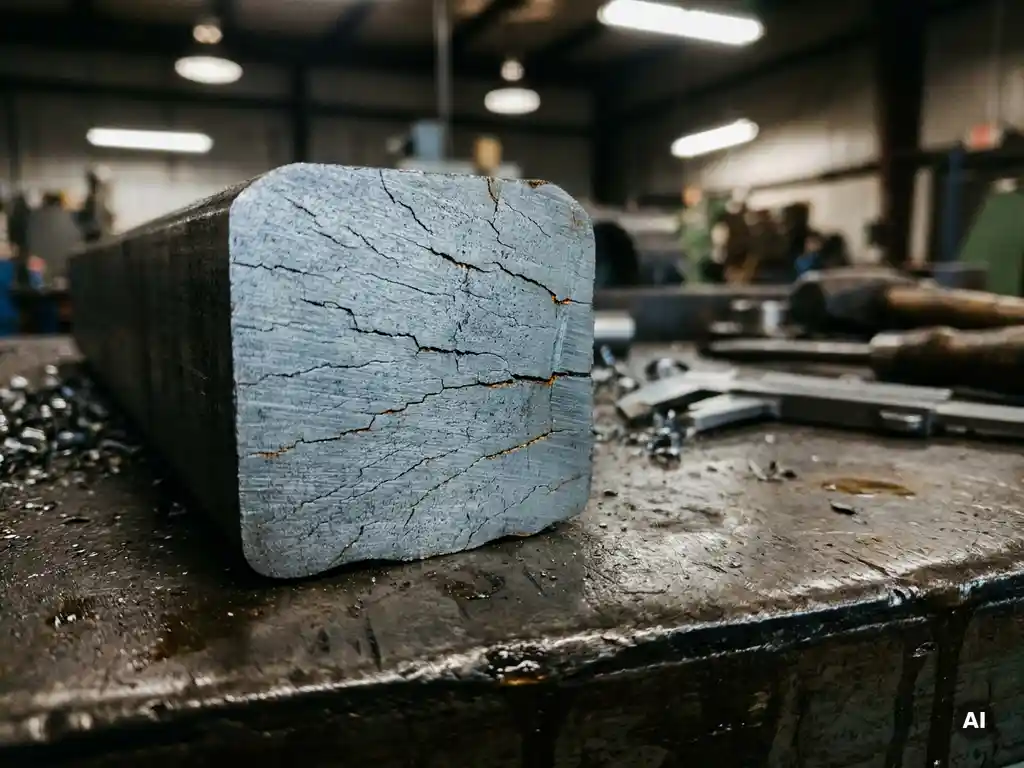
Elevated hydrogen content in steel significantly increases the risk of flaking and cracking because hydrogen atoms, dissolved in liquid steel, become trapped in the solid metal during cooling and generate intense internal pressure at grain boundaries and microstructural defects. When that pressure exceeds the local tensile strength of the steel, internal cracks form spontaneously, often without any external load. The sections below explain the underlying mechanisms, warning signs, high-risk scenarios, and how steelmakers measure and control hydrogen to protect product quality.
How does dissolved hydrogen behave inside solidifying steel?
During solidification, dissolved hydrogen is forced out of solution because solid steel holds far less hydrogen than liquid steel. As the metal transitions from liquid to solid, hydrogen atoms that cannot escape fast enough become trapped within the crystalline structure, migrating toward grain boundaries, non-metallic inclusions, voids, and other microstructural discontinuities where they accumulate under pressure.
Hydrogen enters liquid steel from several sources: moisture in scrap, refractory materials, slag, and the surrounding atmosphere. At steelmaking temperatures, hydrogen dissociates into atomic form, which is small enough to diffuse freely through liquid and solid steel alike. The critical moment comes during cooling. As the steel cools below the solidus temperature, hydrogen solubility drops sharply. Atomic hydrogen that cannot diffuse to the surface in time combines with other hydrogen atoms at internal defect sites, forming molecular hydrogen gas. Because molecular hydrogen cannot diffuse through the steel matrix, it becomes permanently trapped.
The rate at which hydrogen can escape depends heavily on section thickness and cooling speed. Thin sections allow faster diffusion to the surface; heavy forgings, thick plates, and large ingots cool so slowly in their cores that hydrogen has no practical escape route before the steel becomes rigid enough to trap it permanently.
What internal pressure does trapped hydrogen create in steel?
Trapped molecular hydrogen generates internal gas pressure that can reach levels high enough to exceed the cohesive strength of the surrounding steel matrix. At the temperatures and hydrogen concentrations encountered in industrial steelmaking, localized pressures at defect sites can be substantial, particularly in high-strength or low-alloy steels where the material offers less plastic deformation to relieve stress.
The pressure builds progressively as the steel cools to ambient temperature. At elevated temperatures, steel retains some ductility and can accommodate limited stress through plastic deformation. However, as temperature falls and the steel becomes harder and more brittle, the same internal pressure that might have been tolerable at higher temperatures becomes sufficient to initiate and propagate cracks along grain boundaries or through the matrix itself.
This delayed nature of hydrogen damage is one of the most important practical concerns for steelmakers. Cracks may not appear immediately after casting or rolling. They can develop hours or even days after the steel has been processed, making inspection and quality assurance considerably more complex. The phenomenon is sometimes described as delayed fracture or static fatigue, and it is directly linked to the pressure that trapped hydrogen exerts within the microstructure over time.
What are the typical signs of hydrogen-induced flaking?
Hydrogen-induced flaking produces characteristic internal defects that are distinct from surface cracks or mechanical damage. The most recognizable signs are small, roughly circular or elliptical internal cracks oriented perpendicular to the direction of working, often called flakes or snowflakes. On a fracture surface, these appear as bright, silvery areas with a crystalline texture, which is why they are also referred to as white spots in steel.
Key indicators that metallurgists and quality engineers look for include:
- Internal discontinuities detected during ultrasonic testing, typically distributed throughout the cross-section of heavy sections
- Bright, faceted fracture surfaces with a characteristic fisheye or snowflake appearance on broken specimens
- Cracks that follow prior austenite grain boundaries or run through the matrix without a clear external cause
- Defects that appear after cooling and heat treatment rather than immediately after forming
- Higher defect density toward the center of thick sections, where hydrogen concentration is greatest and escape is most restricted
Hydrogen flaking is an internal phenomenon, so visual surface inspection alone is insufficient. Ultrasonic testing is the primary non-destructive method used to detect these defects in finished or semi-finished products. Once flakes are present, the steel cannot be repaired and must be rejected, making prevention far more economical than detection after the fact.
Which steel grades and processes carry the highest hydrogen risk?
Not all steels are equally vulnerable to hydrogen-induced cracking and flaking. The risk depends on steel composition, section size, microstructure, and the hydrogen content introduced during steelmaking. Medium- and high-carbon steels, low-alloy steels containing chromium, molybdenum, nickel, or vanadium, and high-strength structural steels are among the most susceptible grades because their microstructures are less tolerant of internal stress concentrations.
Steel grades with elevated sensitivity
Tool steels, bearing steels, rail steels, heavy plate grades for pressure vessels, and large forgings for engineering applications carry particularly high hydrogen risk. These products are typically produced in large cross-sections, which limits hydrogen diffusion, and their alloying elements increase hardenability and reduce the ductility available to accommodate internal pressure.
Process stages that introduce hydrogen
Hydrogen risk is not confined to a single process step. It accumulates across the steelmaking route:
- Electric arc furnace and converter steelmaking: Wet or contaminated scrap, electrodes, and atmospheric moisture contribute hydrogen to the melt
- Ladle metallurgy: Slag moisture, poorly dried refractory linings, and inadequate degassing leave residual hydrogen in the steel before casting
- Continuous casting and ingot casting: Insufficient vacuum degassing or inadequate ladle practices mean hydrogen is cast into the product
- Slow cooling after rolling or forging: Heavy sections that cool too quickly without controlled annealing trap hydrogen before it can diffuse out
Controlling hydrogen at the ladle stage, before the steel is cast, is particularly important because it is far more difficult to remove hydrogen from solid steel than from liquid steel. This is why ladle metallurgy practices, including vacuum degassing and careful management of moisture sources, are central to producing clean steel with low hydrogen content.
How is hydrogen content in steel measured and controlled?
Hydrogen content in liquid steel is measured using immersion sensors that detect dissolved hydrogen directly in the melt, or through vacuum extraction methods applied to solidified samples. Modern steelworks use online hydrogen measurement systems that provide real-time readings during ladle treatment, allowing metallurgists to make process decisions before the steel is cast. Target hydrogen levels for sensitive grades are typically kept well below a few parts per million by weight.
Measurement methods
Two approaches are widely used in industrial practice. Immersion-based electrochemical sensors can be inserted into the liquid steel in the ladle to give a rapid reading of dissolved hydrogen concentration. Vacuum extraction analysis, applied to solidified steel samples, provides a more precise measurement but requires more time. For critical grades, both methods may be used at different stages of the process.
Control strategies
Controlling hydrogen requires action at every stage where moisture or hydrogen sources can enter the steel:
- Scrap drying and selection: Ensuring that scrap is dry and free of oil, paint, or other hydrogen-bearing contaminants before charging
- Refractory drying: Thoroughly drying ladle linings, slide gate refractories, and other refractory components before contact with liquid steel
- Vacuum degassing: Using vacuum degassing units such as RH or VD degassers to remove dissolved hydrogen from the melt before casting
- Inert gas stirring: Argon stirring during ladle treatment promotes hydrogen removal by creating a low partial pressure environment at the steel surface
- Controlled slow cooling: Applying controlled cooling or annealing cycles to finished products to allow residual hydrogen to diffuse out before the steel becomes too rigid
Maintaining a dry, well-controlled ladle environment is one of the most practical and direct ways to limit hydrogen pickup. Any source of moisture in contact with liquid steel, whether from refractory materials, slag, or the surrounding atmosphere, can raise hydrogen levels and increase the risk of flaking in the finished product. Steelworks producing quality grades pay close attention to every link in this chain, from raw material handling to the final casting operation.
How KNÖLLINGER FLO-TEC supports clean steel production
Controlling hydrogen in steel starts with controlling what enters the ladle and how the steel flows from it. We at KNÖLLINGER FLO-TEC develop and manufacture ladle slide gate systems specifically designed to support clean steel production, helping steelworks reduce the risk of reoxidation, moisture ingress, and contamination during casting.
Our slide gate systems offer practical advantages relevant to hydrogen and steel quality management:
- Systems designed to support inert-gas shielding, helping to limit contact between liquid steel and the atmosphere during the casting process
- Robust construction using temperature-resistant materials suited to demanding ladle metallurgy environments
- Compatibility with different patent-free refractory plate formats, giving steelworks flexibility in refractory sourcing and reducing supply dependency
- Customized solutions for different ladle sizes and operating requirements, including continuous casting and ingot casting applications
- Design principles focused on operational safety and reliable performance under high thermal and mechanical stress
If you produce quality steel grades where hydrogen control and clean steel standards are a priority, we would be glad to discuss how our slide gate systems can support your process. You are welcome to contact our team directly to talk through your specific requirements, or visit our download area for further technical information.
Dieser Inhalt wurde mithilfe von KI erstellt und kann Fehler enthalten.