

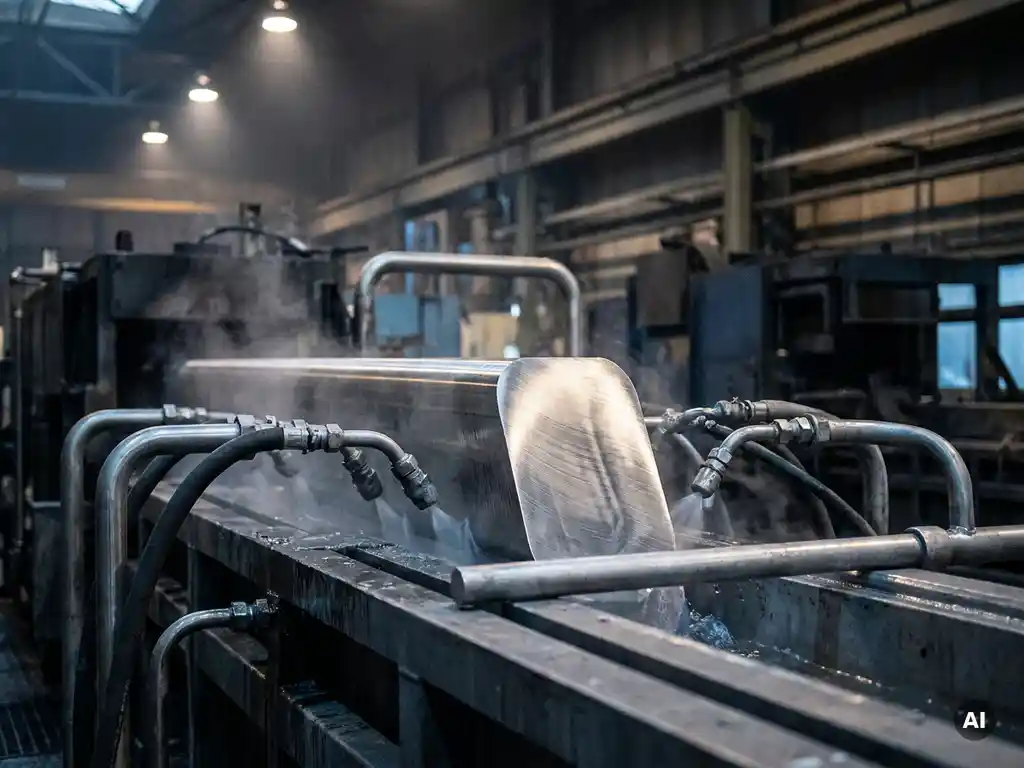
Continuous casting speed directly affects non-metallic inclusion formation because faster casting increases turbulence in the liquid steel, which entrains mold flux, disrupts the solidification front, and reduces the time available for inclusions to float out before they become trapped in the solidifying shell. The relationship is not linear: both excessively high and unnecessarily low casting speeds create conditions that compromise steel cleanliness, though high-speed casting carries the greater risk for most inclusion types. The sections below address the most important questions steelmakers face when managing inclusion formation across varying casting speeds.
How does casting speed change the fluid flow inside the mold?
Casting speed controls the velocity of liquid steel flowing from the submerged entry nozzle into the mold. As speed increases, the momentum of the incoming jet rises, which intensifies the circulation patterns within the mold pool. At higher velocities, the upper recirculation zone becomes more energetic, pushing the meniscus surface into turbulent motion and creating conditions where mold flux can be drawn downward into the steel rather than remaining as a stable protective layer at the top.
At moderate casting speeds, fluid flow follows a relatively predictable double-roll pattern: steel enters through the nozzle ports, flows outward toward the narrow faces, turns upward, and returns across the meniscus before recirculating downward. This controlled pattern supports inclusion flotation because rising currents carry particles toward the surface where the mold flux can absorb them. When casting speed increases beyond the range appropriate for a given mold geometry and nozzle design, the upper roll becomes unstable. Velocity fluctuations at the meniscus cause surface level variations, which in turn promote flux entrapment and reoxidation from atmospheric contact.
Argon injection through the submerged entry nozzle modifies this picture further. Bubbles alter the buoyancy and trajectory of the steel jets, which can either help or hinder inclusion removal depending on flow conditions. At elevated casting speeds, managing argon flow rate becomes more critical because the interaction between bubble columns and the high-velocity jet becomes harder to control.
Why do higher casting speeds trap more inclusions in solidified steel?
Higher casting speeds trap more inclusions in solidified steel primarily because the solidification front advances faster, leaving less time for inclusions to float upward and be absorbed by the mold flux before the steel around them freezes. In addition, the increased turbulence associated with faster casting generates new inclusions by entraining mold flux and promotes reoxidation near the meniscus.
Inclusion entrapment in the solidifying shell is also influenced by the local flow velocity parallel to the solidification front. When this velocity is high, inclusions are swept along the growing dendrites and captured between them rather than being pushed back into the liquid pool. This mechanism means that even inclusions that form early in the process and would normally have sufficient time to float out at lower speeds can become embedded in the shell at higher casting rates.
A further factor is the behavior of the mushy zone, the region between fully liquid steel and the fully solidified shell. At higher casting speeds, the mushy zone extends deeper into the strand, creating a longer region where inclusions can be mechanically trapped between dendrite arms. Once captured in this way, the inclusions cannot be removed by any downstream process and remain as permanent defects in the final product.
What types of non-metallic inclusions are most affected by casting speed?
The inclusion types most sensitive to casting speed are alumina clusters, mold flux droplets, and reoxidation products. Alumina clusters are particularly vulnerable because their irregular, low-density structure makes them susceptible to fluid drag forces: at higher casting speeds, the flow is strong enough to carry clusters into the solidifying shell before they can agglomerate and float out. Mold flux droplets become a significant concern specifically at elevated speeds because meniscus turbulence is the primary mechanism by which flux enters the steel.
Calcium-treated inclusions, which are typically modified to a liquid or semi-liquid state to improve castability, are somewhat less sensitive to casting speed because their spherical morphology and modified composition make them easier to remove by flotation across a range of flow conditions. However, if casting speed increases turbulence to the point where reoxidation occurs, calcium-treated inclusions can be partially reverted or supplemented by new oxide formations.
Sulfide inclusions are generally less affected by casting speed directly, since their formation is primarily controlled by steel chemistry and cooling rate rather than by mold fluid dynamics. However, in grades where sulfides form on the surfaces of pre-existing oxide inclusions, the oxide population influenced by casting speed indirectly shapes the sulfide distribution as well.
What is the optimal casting speed range for clean steel production?
There is no universal optimal casting speed for clean steel production because the appropriate range depends on the combination of mold dimensions, steel grade, nozzle design, argon flow rate, and the specific inclusion cleanliness targets for the product. In general, clean steel casting practice aims for a speed that maintains stable meniscus conditions and a well-controlled double-roll flow pattern without creating excessive surface turbulence or allowing the strand shell to become too thin at the mold exit.
For slab casting of quality steel grades, industry experience shows that meniscus stability is typically maintained within a casting speed window that keeps surface velocity below the threshold at which flux entrainment becomes significant. Exceeding this threshold, even temporarily during speed transients such as ladle changes or tundish level adjustments, can introduce flux-derived inclusions into a section of the strand that would otherwise meet cleanliness specifications.
Speed transients deserve particular attention. Periods of acceleration and deceleration create flow conditions that differ substantially from steady-state operation, and inclusions formed or entrapped during these short windows can appear as localized defect clusters in the final product. Clean steel producers often apply tighter process controls during transient periods, including adjusted argon flow and close attention to tundish level stability, to minimize the impact of unavoidable speed changes.
How does casting speed interact with slide gate operation and inclusion risk?
Slide gate operation and casting speed interact directly through their combined influence on steel flow from the ladle into the tundish and from the tundish into the mold. The slide gate controls the flow rate of liquid steel out of the ladle, and any instability in gate position, partial blockage of the gate opening, or vortex formation above the gate can introduce reoxidation products and entrained air into the tundish stream, which then enter the mold at whatever casting speed the caster is running.
At higher casting speeds, the demand for steel throughput is greater, which means the slide gate must operate at a wider opening or respond more dynamically to maintain tundish level. Wider gate openings can reduce the risk of clogging on the gate itself, but they also change the flow geometry in ways that may promote vortex formation as the ladle empties. A vortex above the gate draws slag from the ladle surface into the tundish, introducing new oxide inclusions regardless of how well the mold flow is controlled downstream.
Inert gas shielding between the ladle and the tundish is one of the key measures used to reduce reoxidation in this part of the process. By limiting contact between the steel stream and atmospheric oxygen during transfer, shielding helps ensure that the inclusion load entering the tundish reflects ladle metallurgy practice rather than being increased by reoxidation at the transfer point. This matters more, not less, as casting speed increases, because higher throughput means more steel passes through the transfer zone per unit of time.
The design and reliability of the ladle slide gate system therefore have a direct bearing on inclusion risk at any casting speed. A system that maintains consistent, controllable flow with minimal leakage paths reduces the variables that metallurgists must compensate for downstream.
How can steelmakers monitor and control inclusions at varying casting speeds?
Steelmakers can monitor and control inclusions at varying casting speeds by combining online process measurements with periodic sample-based analysis. The most useful real-time signals are mold level stability, electromagnetic stirring response, and submeniscus thermocouple readings, all of which provide indirect evidence of flow conditions and potential inclusion entrapment events without requiring interruption of the casting process.
Online monitoring approaches
Mold level sensors are among the most practical tools for identifying conditions associated with elevated inclusion risk. Sudden level fluctuations, particularly during speed changes, indicate meniscus instability that correlates with flux entrapment. Some producers use the standard deviation of mold level as a process indicator, targeting a threshold below which surface turbulence is considered acceptable for the grade being cast. Electromagnetic flow measurement in the mold provides a more direct view of the upper roll velocity, allowing operators to identify when flow conditions have moved outside the range associated with clean steel production.
Offline and metallurgical analysis
Periodic sampling of tundish steel, combined with oxygen activity measurement, gives metallurgists a direct measure of the reoxidation state of the steel entering the mold. If oxygen activity rises unexpectedly at a given casting speed, the source can often be traced to ladle transfer conditions, tundish cover integrity, or slide gate performance. Cleanliness assessment of solidified samples using automated inclusion analysis provides the most detailed picture of inclusion population, size distribution, and composition, allowing process engineers to correlate specific casting speed ranges and operating events with the inclusion characteristics found in the product.
Controlling inclusions across varying casting speeds ultimately requires treating speed not as an isolated variable but as one element of a connected process that runs from ladle metallurgy through tundish practice to mold flow management. Each step in the sequence either adds to or reduces the inclusion load that reaches the solidifying strand.
How KNÖLLINGER FLO-TEC supports clean steel casting
Managing inclusion formation across varying casting speeds depends on consistent, reliable flow control at every stage of the process, and the performance of the ladle slide gate system is central to that consistency. We design our slide gate systems specifically for the demands of quality steel production, with the following in mind:
- Inert gas shielding capability: Our GT series slide gate systems can be flooded with inert gas such as argon, helping to reduce contact between the steel stream and atmospheric oxygen during ladle transfer and thereby limiting reoxidation-derived inclusions entering the tundish.
- Reliable, controllable flow: Our systems are built to maintain stable, predictable steel flow across the range of gate positions required during normal casting and speed transients, reducing the flow instabilities that contribute to vortex formation and slag entrapment.
- Operational safety: The enclosed design helps contain steel in the event of a leak, supporting safe operation even under the demanding conditions of high-throughput casting.
- Compatibility with patent-free refractory plate formats: Our systems can be adapted to accommodate different plate formats through suitable modifications, giving steelworks flexibility in refractory sourcing and reducing dependence on a single supplier.
- Customized solutions: We develop slide gate systems to match specific ladle sizes and operational requirements, so the system fits the process rather than the other way around.
If you want to discuss how our slide gate systems can support your clean steel targets at your specific casting speeds and ladle configurations, contact our team directly. You can also explore our product range or download technical documentation to review our systems in more detail.
Dieser Inhalt wurde mithilfe von KI erstellt und kann Fehler enthalten.