

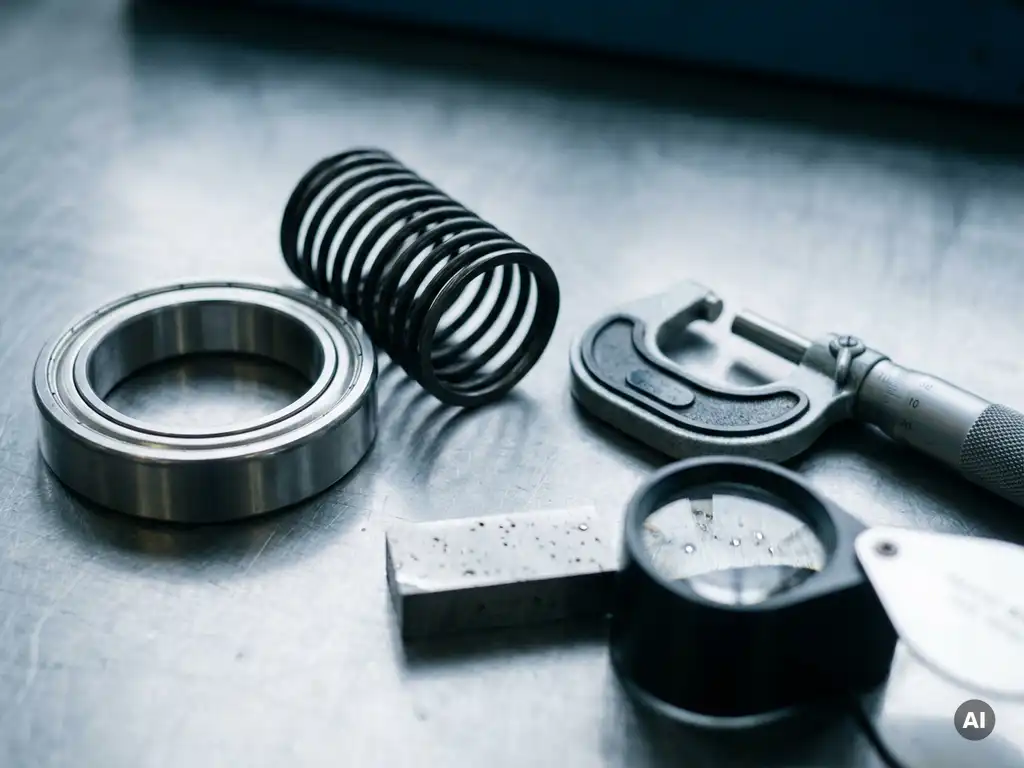
Bearing and spring steels require stricter cleanliness targets than structural grades because they operate under cyclic fatigue loading, where even small non-metallic inclusions act as stress concentrators that initiate cracks. Structural steels carry predominantly static or low-cycle loads, so the same inclusion that would cause no measurable harm in a beam or column can cause early fatigue failure in a bearing ring or valve spring. The sections below work through the key questions that explain why inclusion control matters so much in these demanding grades.
What types of inclusions make bearing and spring steels fail prematurely?
The inclusions most damaging to bearing and spring steels are hard, brittle oxide and silicate particles, particularly alumina clusters, calcium aluminate stringers, and titanium nitrides. These particles are poorly bonded to the steel matrix, creating sharp interfaces where fatigue cracks nucleate under repeated stress cycles. Sulfide inclusions are less harmful in isolation but become problematic when they wrap around oxide cores, extending the effective defect size.
In bearing steel, the critical concern is large globular or clustered alumina inclusions. Alumina is significantly harder than the steel matrix and does not deform during rolling, so it sits as a rigid discontinuity in an otherwise ductile structure. Titanium nitrides are equally dangerous because they form as angular, faceted particles with sharp corners that concentrate stress with particular efficiency.
Spring steels share these vulnerabilities but add a further sensitivity to surface-connected inclusions. A spring loaded in bending or torsion experiences its highest stress at or near the surface, so even a small inclusion close to the surface can reduce fatigue life dramatically. For this reason, spring steel specifications often address both total inclusion content and the maximum allowable inclusion size near the surface.
How do fatigue loading conditions amplify the effect of inclusions?
Fatigue loading amplifies the effect of inclusions because stress concentrates at inclusion boundaries, and repeated loading cycles progressively extend the microcrack that forms there. Under static loading, the surrounding steel matrix can redistribute stress around a small defect. Under cyclic loading, the crack grows incrementally with each cycle until it reaches a critical length and propagates rapidly to fracture.
The severity of this effect depends on inclusion size, shape, and position relative to the surface. Larger inclusions create larger stress concentration zones. Angular inclusions with sharp edges are worse than rounded ones. Inclusions located in the subsurface region of a bearing raceway, where contact stresses peak, are exposed to the highest cyclic stress amplitude and therefore initiate cracks most readily.
This is why bearing steel specifications focus not just on average cleanliness but on the worst-case inclusion in a given volume of steel. A single large alumina cluster in an otherwise clean heat can determine the fatigue life of every bearing ring produced from that heat. Statistical approaches to inclusion assessment, such as extreme value analysis, are used precisely because the tail of the inclusion size distribution, not the average, governs component life.
What cleanliness standards apply to bearing and spring steels?
Bearing steels are typically assessed against standards such as ASTM E45, ISO 4967, or the SEP 1571 method, which categorize inclusions by type and severity rating. High-quality bearing steel grades, including 100Cr6 and its variants, are commonly specified to the lowest achievable rating levels for type D (globular oxide) inclusions, with total oxygen content targets often in the range of 5 to 10 parts per million by mass.
Spring steel cleanliness requirements vary by application but are generally more demanding than structural grades and comparable in some respects to bearing steel. Valve spring wire, which operates at high frequency and high stress amplitude, is among the most stringent applications in the entire steel industry. Specifications for this material often require very low total oxygen, tight control on sulfur, and explicit limits on inclusion size and distribution confirmed by ultrasonic testing of the rod or wire.
It is worth noting that cleanliness standards for these grades have become progressively more demanding over time as component designers push for higher load ratings, longer service intervals, and reduced weight. A cleanliness level that was considered acceptable for bearing steel production a generation ago may no longer satisfy the requirements of modern automotive or industrial bearing applications.
Which steelmaking steps control cleanliness in these critical grades?
Cleanliness in bearing and spring steels is controlled across the entire secondary metallurgy and casting sequence, not at any single step. The primary contributors are ladle furnace refining, vacuum degassing, calcium treatment decisions, inclusion flotation time, and the casting process itself.
Ladle furnace refining and vacuum degassing
Ladle furnace refining establishes a reducing slag chemistry that absorbs inclusions from the steel bath. Vacuum degassing, particularly through RH or VD treatment, removes dissolved oxygen and hydrogen, drives deoxidation reactions to completion, and allows the resulting oxide particles to float out into the slag. Sufficient holding time after degassing is important because inclusion removal depends on particles reaching the slag layer before casting begins.
Deoxidation practice and calcium treatment
Aluminum deoxidation is standard for bearing steel because it achieves very low oxygen levels, but it produces solid alumina inclusions that are difficult to remove and harmful if they remain. Calcium treatment modifies alumina to liquid calcium aluminates that float more readily, but the treatment must be carefully controlled. Excess calcium can produce calcium sulfide particles or reform solid inclusions if the composition window is missed. For some spring steel grades, silicon-manganese deoxidation is preferred precisely to avoid solid alumina formation.
How does reoxidation during casting undermine upstream refining?
Reoxidation during casting reintroduces oxygen into steel that has already been refined to very low oxygen levels, generating fresh inclusions in the liquid steel just before or during solidification. These late-forming inclusions cannot be removed by flotation because there is no longer sufficient time or liquid volume for them to reach a slag interface. They become trapped in the solidified structure and are often larger and more damaging than inclusions formed earlier in the process.
The main sources of reoxidation during casting are air contact with the steel stream, reactions between steel and oxidized refractories, and turbulence-driven slag entrainment. Each of these mechanisms can negate hours of careful ladle metallurgy in a matter of seconds.
Protecting the steel stream from air contact is therefore a direct requirement for bearing and spring steel production. Shrouding between the ladle and the tundish, submerged entry nozzles into the mold, and inert-gas shielding at exposed transfer points all serve to keep atmospheric oxygen away from the liquid steel. The ladle slide gate system is a relevant part of this picture because it controls the initial flow from the ladle and, in systems designed for clean steel applications, can support inert-gas purging to reduce the oxygen exposure of the steel stream at the point of transfer.
Refractory quality at the ladle outlet is equally important. Oxidized or poorly conditioned refractory surfaces can react with the steel and generate inclusion bursts, particularly at the start of casting when the initial steel flow contacts cold or marginally oxidized surfaces. Consistent refractory condition and reliable flow control are practical prerequisites for maintaining the cleanliness achieved in the ladle.
Should all steel grades be produced to bearing-steel cleanliness levels?
No. Producing all steel grades to bearing-steel cleanliness levels would be technically unnecessary and economically unjustifiable. Structural grades used in construction, general engineering, or low-cycle applications carry loads that are either static or well below the fatigue threshold where inclusion size becomes critical. The cost and process time required for vacuum degassing, extended holding periods, and tight inclusion control add no practical benefit to these grades.
The correct approach is to match cleanliness targets to the actual loading conditions and failure modes of the end application. A reinforcing bar, a ship plate, or a general structural section tolerates a much higher inclusion content without any reduction in service performance. Applying bearing-steel process discipline to these grades would consume vacuum degassing capacity, extend tap-to-cast times, and increase production costs without improving the product.
Where the distinction matters is in plants that produce a mix of grades. Scheduling and process sequencing need to ensure that the stringent practices required for bearing and spring steel heats do not carry contamination risk into adjacent heats, and that the additional process steps are allocated only where the product specification genuinely requires them. Grade-appropriate cleanliness targets, clearly defined and consistently enforced, are the practical standard across a well-managed melt shop.
How KNÖLLINGER FLO-TEC supports clean steel production
We develop and supply ladle slide gate systems specifically for steelworks that take steel cleanliness seriously. For plants producing bearing steels, spring steels, and other demanding grades, the performance of the ladle outlet system directly affects whether the cleanliness achieved in secondary metallurgy survives through to the cast product.
Our systems are designed with the following priorities in mind:
- Inert-gas shielding capability: Our GT-series slide gates can be flooded with inert gas such as argon to help reduce contact between the steel stream and atmospheric oxygen at the point of transfer, supporting the clean steel targets your refining process has established.
- Reliable flow control: Consistent, controllable flow from the ladle reduces turbulence and the risk of slag entrainment, both of which are sources of reoxidation and inclusion generation during casting.
- Compatibility with different refractory plate formats: Our systems can be adapted to accommodate a range of patent-free refractory plate formats, giving your purchasing team flexibility and reducing dependence on a single refractory supplier.
- Robust construction for demanding operating conditions: Systems are built to withstand the thermal and mechanical stresses of steelmaking, with a design that supports operational safety and reliable containment in the event of a leak.
- Customized solutions: We develop slide gate systems to suit different ladle sizes and operating requirements, including customer-specific configurations where standard designs do not fully meet the application.
If your plant is working toward tighter cleanliness targets for bearing or spring steel grades, we are glad to discuss how our slide gate systems can support your process. You can also download technical documentation or contact us directly to speak with one of our specialists.
Dieser Inhalt wurde mithilfe von KI erstellt und kann Fehler enthalten.