
'/%3E%3C/svg%3E)
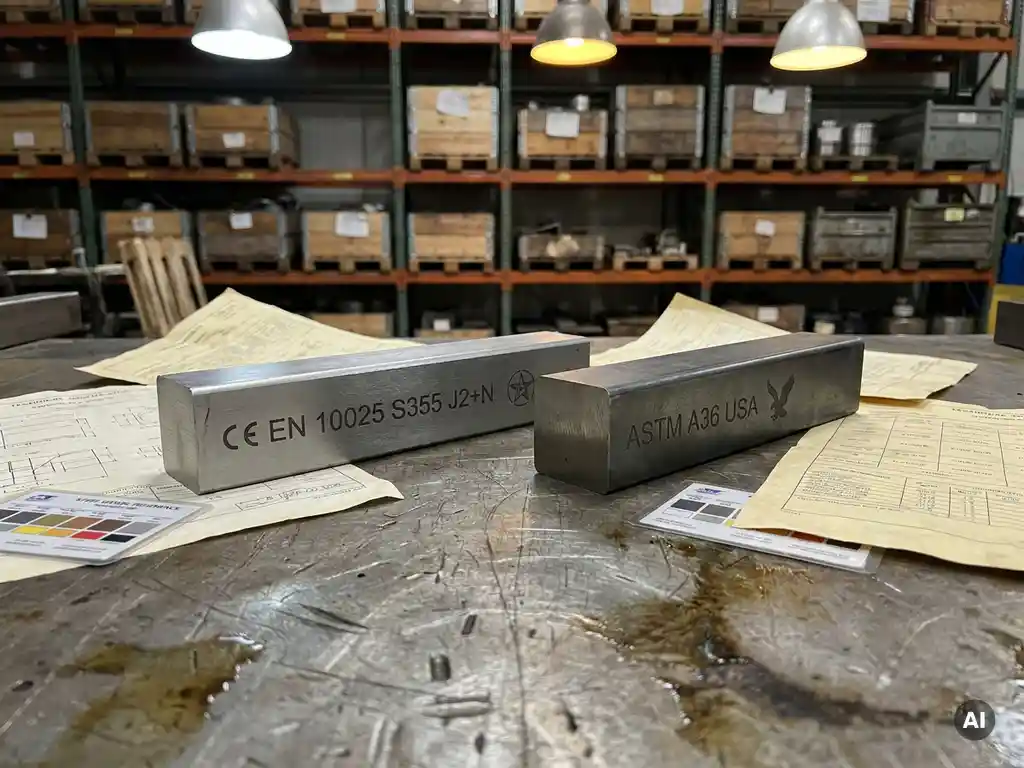
EN 10083 and ASTM A29 differ in how they classify, specify, and guarantee steel grades, which means a grade listed under one standard is rarely a direct substitute for a grade listed under the other. EN 10083 is the European standard for quenched and tempered steels, while ASTM A29 is the American standard covering hot-wrought carbon and alloy steel bars. For steel buyers working across borders, understanding these differences is not just a technical formality; it directly affects whether your material will meet the mechanical and quality requirements of your application.
The sections below address the most common questions buyers raise when comparing these two specifications, from grade definitions and guaranteed properties to interchangeability and delivery conditions.
How do EN 10083 and ASTM A29 define steel grades differently?
EN 10083 defines steel grades primarily by guaranteed mechanical properties after heat treatment, with chemical composition serving as a supporting parameter. ASTM A29 defines grades almost entirely by chemical composition, with mechanical properties left to supplementary specifications or the end-use product standard. This fundamental difference in approach shapes every practical comparison between the two systems.
Under EN 10083, a grade such as 42CrMo4 comes with defined tensile strength ranges, yield strength minimums, and impact energy values that the supplier must guarantee for specified diameter ranges and delivery conditions. The designation itself encodes the carbon content and alloying elements, but the standard’s value to the buyer lies in the property guarantees attached to it.
ASTM A29, by contrast, establishes the chemical composition limits for each grade, for example, 4140 steel, but does not itself mandate specific tensile or yield strength values. Those properties depend on the heat treatment applied, which may be defined in a separate product standard, a customer specification, or a purchase order supplement. A buyer ordering to ASTM A29 alone is essentially specifying chemistry, not performance.
Which mechanical properties are guaranteed under each standard?
EN 10083 guarantees minimum tensile strength, yield strength, elongation, and often Charpy impact values, all dependent on the product form and diameter range. ASTM A29 does not guarantee mechanical properties on its own; it specifies chemical composition only, and mechanical requirements must come from a separate standard or a supplementary purchase requirement.
This distinction matters significantly for buyers in demanding applications such as pressure vessels, structural components, or parts subject to fatigue loading. When you order to EN 10083, you receive a document-backed guarantee that the delivered material, after the specified heat treatment, will reach defined strength levels. The test results are part of the material certificate.
When you order to ASTM A29 without supplementary requirements, the mill certifies chemistry. If you also need certified mechanical properties, you must explicitly invoke a supplementary requirement, for example, referencing ASTM A29 Supplementary Requirement S1 for tension tests, or specify an additional product standard that mandates mechanical testing. Buyers who overlook this step may receive material that is chemically correct but has no documented mechanical performance.
Are EN 10083 and ASTM A29 grades directly interchangeable?
EN 10083 and ASTM A29 grades are not directly interchangeable, even when chemical compositions appear similar. Differences in permissible composition ranges, heat treatment conditions, testing requirements, and property guarantees mean that a nominal equivalent, such as 42CrMo4 and 4140, can behave differently in service or fail to meet the other standard’s certification requirements.
Nominal cross-references between European and American grades exist in reference tables and are widely used in industry as starting points. However, these are engineering approximations, not certified equivalences. The permissible ranges for elements such as chromium, manganese, or silicon may differ between the two standards, and even small compositional differences can influence hardenability, toughness, or weldability.
Beyond chemistry, the certification and testing regimes differ. A mill certificate issued to EN 10083 will include mechanical test results and heat treatment condition. A certificate issued to ASTM A29 will show chemistry. If your quality system, customer specification, or regulatory requirement calls for one standard, substituting material certified to the other requires explicit engineering review and, in many cases, customer approval. Treating them as equivalent without this review is a supply chain risk, not a shortcut.
What does the delivery condition specification mean for each standard?
Under EN 10083, the delivery condition is a defined part of the specification and determines which mechanical property values apply. Common delivery conditions include normalized (+N), quenched and tempered (+QT), and annealed (+A). The standard assigns different property ranges to each condition, and the mill must deliver and test the material in the specified condition. Under ASTM A29, delivery condition is not standardized in the same way; it is typically agreed between buyer and supplier or defined by the downstream product standard.
For buyers, the EN 10083 approach offers a clearer framework at the point of order. You specify the grade, the diameter range, and the delivery condition, and the standard tells you exactly which properties to expect on the test certificate. This reduces ambiguity in procurement and simplifies incoming inspection.
With ASTM A29, the buyer carries more responsibility for defining the complete requirement. If you need material in a specific heat treatment state with certified properties, you must state this explicitly in the purchase order, referencing the appropriate supplementary requirements or product standard. Experienced procurement teams in the American market are accustomed to this approach, but buyers more familiar with European practice can underspecify if they apply EN 10083 habits to an ASTM A29 order.
Which standard should steel buyers specify for cross-border supply chains?
For cross-border supply chains, the standard to specify depends on where the material will be used, what the end-use specification requires, and which mills you intend to source from. EN 10083 is the natural choice for European end-use applications; ASTM A29 fits American supply chains. When sourcing globally, specifying both the chemistry and the required mechanical properties explicitly, regardless of which standard framework you use, gives you the clearest basis for comparison and qualification across suppliers in different regions.
In practice, many international buyers operating in Europe, the United States, Turkey, or the Middle East encounter situations where a local mill can supply to one standard but not the other. Requiring dual certification, material tested and documented to meet both EN 10083 and ASTM A29 requirements simultaneously, is one approach, though not all mills offer this and it adds cost and lead time.
A more pragmatic approach is to define your actual technical requirements, chemistry limits, strength ranges, impact requirements, and testing frequency, in your own purchase specification, and then reference the applicable standard as the baseline. This way, you can qualify suppliers in different markets against a consistent internal benchmark, regardless of whether their default documentation follows European or American conventions.
For applications in steelmaking environments, where material quality directly affects process reliability and product integrity, the choice of specification framework is worth the time to get right. Poorly specified incoming material can introduce variability that propagates through the entire production process.
How KNÖLLINGER FLO-TEC supports steel quality in demanding applications
At KNÖLLINGER FLO-TEC, we work with steelworks that take material quality seriously, plants where the specification of every component in the process matters. Our ladle slide gate systems are designed to support clean steel production and reliable flow control, helping steelworks maintain the process consistency that high-grade steel production demands. If you are evaluating your ladle flow control equipment alongside your material and process specifications, we are glad to discuss what our systems can offer your operation.
- Slide gate systems designed for clean steel production, with inert-gas shielding capability to help reduce reoxidation during casting
- Solutions compatible with a range of patent-free refractory plate formats, giving your procurement team flexibility across suppliers
- Customized configurations for different ladle sizes and operating requirements, including continuous casting and ingot casting applications
- Robust construction focused on operational safety and reliable performance under demanding metallurgical conditions
You can learn more about our slide gate systems or contact us directly to discuss your specific requirements. Our team is available to support technical evaluation and specification work for steelworks across Europe, the United States, Turkey, and the Middle East.
Dieser Inhalt wurde mithilfe von KI erstellt und kann Fehler enthalten.