
'/%3E%3C/svg%3E)
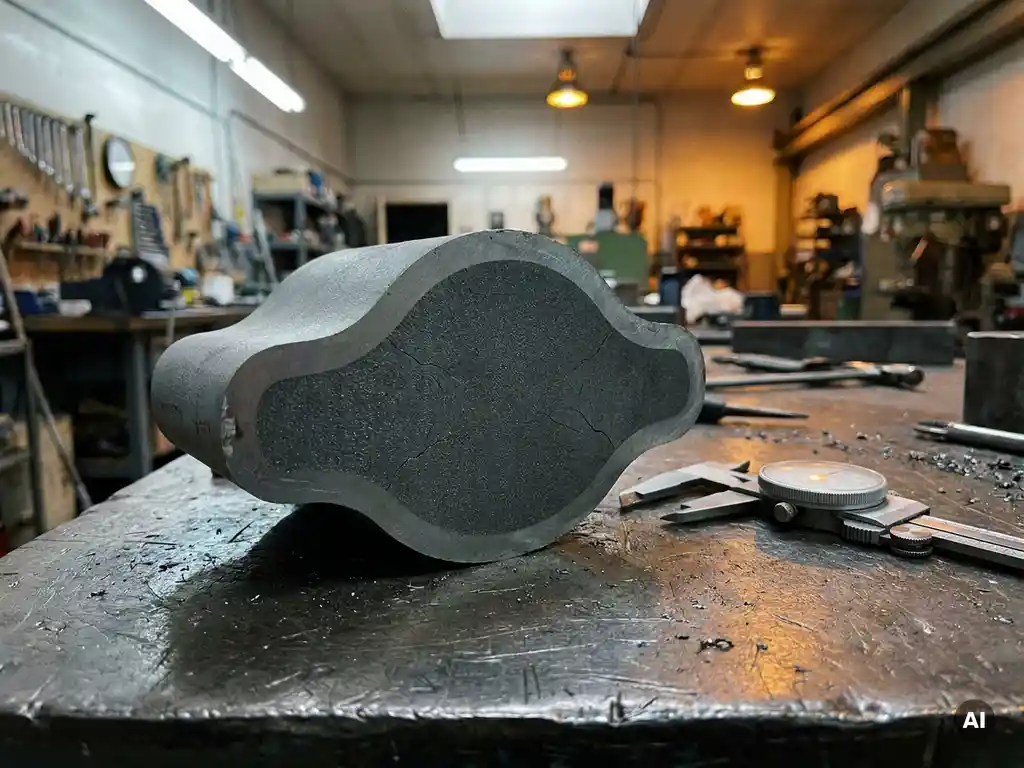
White spot defects in high-alloy steel forgings are internal hydrogen-induced cracks that appear as bright, silvery-white areas on a fracture surface or as bright spots on a polished and etched cross-section. They form when dissolved hydrogen trapped in the steel cannot escape quickly enough during cooling, building up internal pressure that exceeds the local tensile strength of the material. The following sections address the key questions metallurgists and forging engineers ask about this persistent quality problem.
How do white spots form inside steel forgings?
White spots form through a hydrogen embrittlement mechanism: dissolved hydrogen atoms migrate to internal stress concentrations, recombine into molecular hydrogen gas, and generate pressure that initiates small internal cracks. These cracks are typically oriented perpendicular to the maximum principal stress and appear as bright, flat fracture facets. Because the process is driven by diffusion, it usually occurs during or shortly after cooling from the forging temperature, not during hot deformation itself.
The driving force is the steep drop in hydrogen solubility as steel cools from austenite to ferrite or martensite. At elevated temperatures, steel can hold relatively large amounts of hydrogen in solid solution. As the temperature falls, that solubility drops sharply, forcing hydrogen to diffuse toward regions of lower hydrostatic stress, such as grain boundaries, non-metallic inclusions, and micro-voids. When the local hydrogen concentration exceeds a critical threshold and the surrounding microstructure cannot accommodate the resulting pressure, a crack initiates. Over time, adjacent cracks may link up, producing the characteristic white spot pattern seen on macroetched cross-sections.
Why are high-alloy steels more susceptible to white spots?
High-alloy steels are more susceptible to white spot defects because their alloying elements slow hydrogen diffusion, increase hardenability, and promote microstructures that are more sensitive to hydrogen embrittlement. Chromium, nickel, molybdenum, and vanadium all reduce the diffusion coefficient of hydrogen in steel, meaning that hydrogen trapped during solidification takes far longer to escape during cooling. At the same time, these elements raise hardenability, so large forgings cool into hard, brittle martensitic or bainitic structures that offer little resistance to hydrogen-induced cracking.
The combination of slow diffusion and a brittle matrix is particularly dangerous. In a plain carbon steel, hydrogen can diffuse out relatively quickly, and the ferritic microstructure has enough ductility to tolerate moderate hydrogen concentrations. In a highly alloyed tool steel, die steel, or rotor steel, neither of these safety mechanisms operates effectively. This is why white spots are predominantly a problem in large, heavy-section forgings of alloy steels rather than in commodity carbon steel products.
What role does hydrogen content play in white spot formation?
Hydrogen content in the liquid steel is the primary controllable variable in white spot formation. Even small concentrations, measured in parts per million, are sufficient to cause defects in susceptible alloys and large cross-sections. The risk increases with hydrogen content, but there is no universal safe threshold that applies to all steel grades and forging sizes. The critical level depends on the diffusion characteristics of the alloy, the section size, and the cooling conditions after forging.
Hydrogen enters liquid steel from multiple sources: moisture in scrap, electrodes, and refractory materials; atmospheric humidity absorbed during melting; and chemical reactions between steel and slag or air during tapping and transfer. Controlling each of these entry points is central to any strategy for reducing white spot risk. Vacuum degassing, particularly vacuum arc degassing or vacuum oxygen decarburization, is the most effective way to remove dissolved hydrogen before the steel is cast, typically reducing hydrogen to levels well below those at which white spots are likely to form in most alloy grades.
Hydrogen pick-up during casting and transfer is a separate concern. Reoxidation events, turbulent flow, and exposure of the melt to humid air during the transfer from ladle to mold can reintroduce hydrogen even after successful degassing. This is one reason why controlling the casting environment and minimizing air contact during the entire liquid steel handling process matters for final forging quality.
How do cooling rate and forging practice affect white spot risk?
Cooling rate after forging is one of the most influential process variables for white spot formation. Slow, controlled cooling gives hydrogen more time to diffuse out of the forging before the temperature drops to the range where hydrogen embrittlement becomes critical. Rapid cooling, by contrast, locks hydrogen into the microstructure before it can escape, dramatically increasing the risk of white spot formation in susceptible alloys.
Standard practice for large high-alloy forgings includes holding the forging in a furnace at an intermediate temperature after hot working, then cooling very slowly, often over many hours or days depending on the section size and alloy composition. This post-forge heat treatment, sometimes called a hydrogen diffusion anneal, is designed specifically to allow hydrogen to migrate to the surface and escape before the steel reaches temperatures where diffusion becomes negligibly slow.
Forging practice itself also plays a role. Adequate hot reduction improves the internal soundness of the forging by closing porosity and refining the as-cast structure, both of which reduce the number of sites where hydrogen can accumulate. Insufficient reduction leaves a coarser structure with more potential trapping sites. However, even excellent forging practice cannot compensate for excessive hydrogen content in the original cast material, which is why melt quality control and degassing remain the primary line of defense.
How is clean steel production used to prevent white spot defects?
Clean steel production reduces white spot defects by minimizing the hydrogen content and inclusion density of the liquid steel before it is cast. Lower hydrogen content directly reduces the driving force for white spot formation. Fewer and smaller non-metallic inclusions remove the preferred nucleation sites where hydrogen accumulates and cracks initiate. Together, these measures make the steel inherently more resistant to hydrogen-induced damage during cooling and heat treatment.
Key process steps in a clean steel approach for forging-grade alloy steels include careful raw material selection to minimize moisture and hydrogen-bearing contaminants, effective ladle metallurgy to refine and homogenize the melt, vacuum degassing to reduce dissolved hydrogen and other gases, and controlled casting conditions that minimize reoxidation and turbulence. Each step in the liquid steel handling chain represents an opportunity either to remove hydrogen and inclusions or, if poorly controlled, to reintroduce them.
Protecting the liquid steel from air contact during transfer and casting is particularly relevant. When steel flows from the ladle through an unshielded stream, it picks up oxygen and nitrogen from the atmosphere, and moisture from the air contributes to hydrogen uptake. Inert-gas shielding of the steel stream during transfer and casting helps limit this reoxidation and atmospheric contamination, supporting the hydrogen reduction achieved during degassing. The integrity of the flow control system at the ladle outlet is therefore directly connected to the cleanliness of the steel that reaches the mold.
How are white spot defects detected in finished forgings?
White spot defects in finished forgings are detected primarily through ultrasonic testing and macroetching. Ultrasonic testing is the standard non-destructive method for production inspection: the internal cracks that constitute white spots reflect ultrasonic waves, producing characteristic indications that trained operators can identify and locate within the forging. The sensitivity of ultrasonic inspection depends on the probe frequency, the grain size of the steel, and the size and orientation of the defects.
Macroetching is a destructive technique applied to test coupons or sacrificial sections cut from the forging. The cross-section is polished and treated with an acid etchant that reveals the internal structure, making white spots visible as bright, flat areas against the darker etched background. Macroetching provides direct visual confirmation and is often used to validate non-destructive inspection procedures or to investigate failures.
Magnetic particle inspection can detect white spots that are close to the surface or have propagated to the surface, but it is not effective for deeply buried defects. Dye penetrant testing has similar limitations. For the large, heavy-section forgings where white spots are most common, ultrasonic testing remains the primary production inspection method, supplemented by destructive examination of test material where the quality specification requires it.
Some specifications also require hydrogen content measurement of the liquid steel during production as a process control measure, using methods such as vacuum extraction or in-line sensors. Meeting a maximum hydrogen specification at the casting stage does not guarantee the absence of white spots, but it provides evidence that the melt quality was within the range required to minimize risk.
How KNÖLLINGER FLO-TEC supports clean steel quality in forging applications
Preventing white spot defects starts in the liquid steel phase, and that means every step of ladle handling and casting matters. We develop and supply ladle slide gate systems designed to support clean steel production in steelworks that supply forging-grade alloy steels. Our systems are built around several principles that are directly relevant to the quality challenges described in this article:
- Inert-gas shielding capability: Our GT-series slide gate systems can be flooded with inert gas such as argon to help reduce contact between the steel stream and atmospheric oxygen, limiting reoxidation and associated hydrogen pick-up during casting.
- Reliable flow control: Precise, consistent control of the steel stream from the ladle reduces turbulence and minimizes the risk of air entrainment, both of which contribute to cleaner steel at the mold.
- Flexible plate compatibility: Our systems are designed to work with a range of patent-free refractory plate formats, giving steelworks flexibility in their refractory supply without compromising system performance.
- Robust construction for demanding conditions: Systems are built to handle the thermal and mechanical stresses of high-alloy steel casting, where consistent performance directly affects product quality.
- Customized solutions: We develop slide gate configurations adapted to specific ladle sizes and operating requirements, so the system fits the process rather than the other way around.
If you produce forging-grade alloy steels and want to discuss how your ladle flow control setup supports your clean steel targets, get in touch with our team to talk through your specific requirements. You can also download technical documentation to learn more about our product range.
Dieser Inhalt wurde mithilfe von KI erstellt und kann Fehler enthalten.