

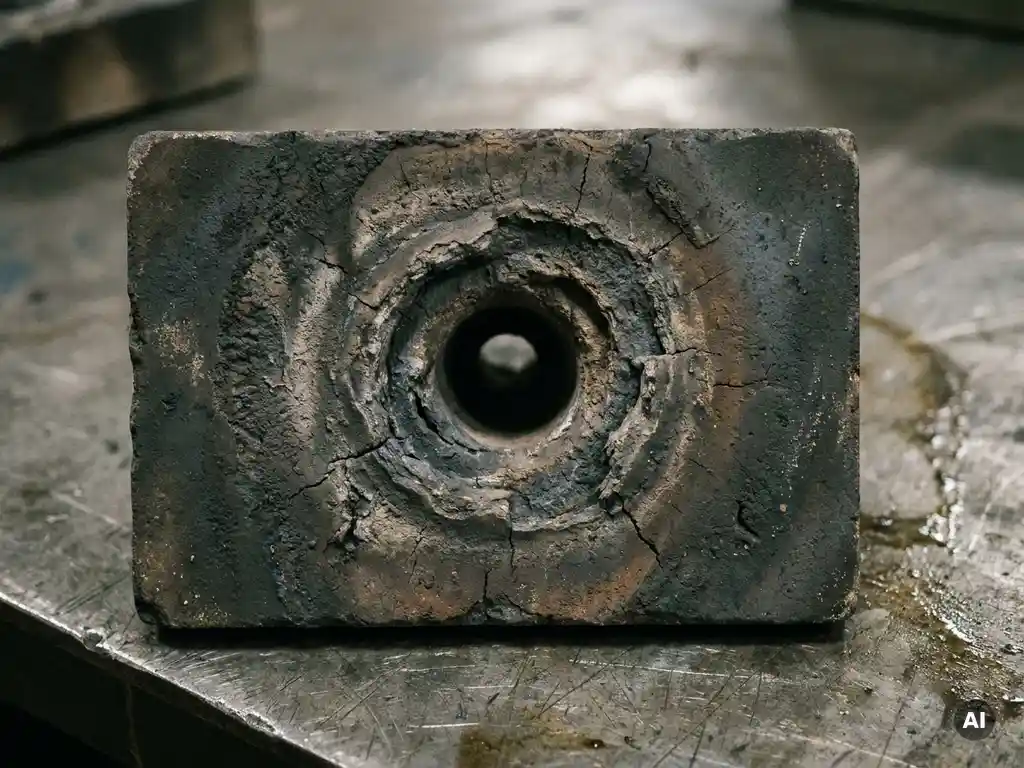
Premature refractory plate failure in steel casting is most commonly caused by a combination of thermal shock, oxygen infiltration, chemical attack from slag and steel chemistry, and mechanical stress from improper gate actuation. No single factor acts in isolation. In most cases, plates fail earlier than expected because two or more of these mechanisms are working together, accelerating wear beyond what any one cause would produce on its own. The sections below address each cause in detail, along with practical guidance on extending plate service life in demanding casting operations.
What are the most common causes of refractory plate wear in ladle slide gates?
The most common causes of refractory plate wear in ladle slide gates are thermal shock from rapid temperature cycling, chemical erosion from aggressive steel grades and slag, oxygen infiltration that promotes reoxidation and surface degradation, and mechanical damage from misaligned or improperly actuated gate systems. In most steelworks, these factors combine rather than act independently, which is why premature slide gate plate failure is rarely traceable to a single root cause.
Understanding these causes matters because refractory plate failure does not just mean an unplanned equipment change. It can mean quality defects in the cast product, operational delays, and in serious cases, a safety risk if a leak develops inside the slide gate system. For metallurgists and quality managers responsible for high-demand casting operations, identifying which failure mode dominates in a given application is the first step toward addressing it effectively.
The causes of premature refractory wear can be grouped into four main categories:
- Thermal mechanisms: rapid heating and cooling cycles that stress the plate material
- Chemical mechanisms: attack from steel chemistry, slag composition, and dissolved gases
- Oxidative mechanisms: oxygen infiltration that degrades both the plate surface and the steel quality
- Mechanical mechanisms: cracking and fracture from gate actuation forces or poor plate seating
Each of these is worth examining separately, because the corrective action for thermal shock is very different from the corrective action for chemical erosion or mechanical misalignment.
How does thermal shock damage refractory plates during casting?
Thermal shock damages refractory plates when rapid, uneven temperature changes create internal stresses that exceed the material’s tensile strength. Refractory materials are strong under compression but relatively brittle under tension. When the surface of a plate heats up or cools down faster than its interior, differential expansion and contraction generate cracks that progressively weaken the plate structure over successive casting cycles.
The most critical thermal events in ladle slide gate operation occur at the start and end of each casting sequence. When a cold or inadequately preheated ladle is opened, the refractory plate is exposed almost instantly to molten steel at temperatures typically above 1,550 degrees Celsius. The surface layer expands rapidly while the cooler interior resists. This gradient creates tensile stress at the surface that can initiate microcracks, even if the plate appears intact after the first heat.
These microcracks are cumulative. A plate that survives several heats without visible damage may still be accumulating subsurface fractures that reduce its effective load-bearing cross-section. When those cracks eventually propagate to the plate surface or through the bore area, the result is spalling, bore enlargement, or sudden fracture during casting.
Proper ladle preheating practices significantly reduce the rate of thermally induced refractory plate wear. Gradual, controlled heating allows the plate material to reach operating temperature more uniformly, reducing the thermal gradient across the plate thickness. Equally important is avoiding unnecessary cooling between heats, which forces the plate through additional thermal cycles and compounds the cumulative damage.
Why does oxygen infiltration accelerate refractory plate degradation?
Oxygen infiltration accelerates refractory plate degradation because atmospheric oxygen reacts chemically with both the molten steel and the refractory material itself. In the zone immediately around the slide gate bore, even small amounts of oxygen ingress can cause localized oxidation of the plate surface, weakening the refractory matrix and enlarging the bore over time. Simultaneously, reoxidation of the steel at this point generates oxide inclusions that can become embedded in or abrade the plate surface.
The problem is particularly significant in continuous casting operations where the gate remains partially open for extended periods. Any gap in the sealing between the plate surfaces or around the gate housing creates a pathway for atmospheric air to be drawn in by the negative pressure that develops around a flowing steel stream. This phenomenon, sometimes called aspiration, is a well-recognized source of both refractory wear and steel quality problems.
For steelworks producing clean steel grades for demanding applications such as energy sector components, oxygen infiltration at the slide gate is a direct threat to product quality. Oxide inclusions formed at this stage of the process are difficult to remove downstream and can compromise the mechanical properties of the finished product.
Inert gas shielding at the slide gate is one of the most effective ways to address this problem. By maintaining a protective atmosphere of argon or another inert gas in the gate area, contact between the molten steel stream and atmospheric oxygen can be substantially reduced. This approach benefits both refractory plate service life and steel cleanliness at the same time. The GT slide gate series is specifically designed to support inert gas application in the slide gate zone, addressing exactly this challenge in clean steel production environments.
What role do steel grade and slag composition play in plate erosion?
Steel grade and slag composition play a significant role in refractory plate erosion because different steel chemistries and slag systems attack refractory materials at different rates and through different mechanisms. High-alloy steels, steels with elevated manganese or chromium content, and steels processed with highly basic slags can all accelerate chemical wear of the plate material beyond what standard operating conditions would suggest.
The primary chemical attack mechanisms are dissolution and infiltration. In dissolution, the molten steel or slag directly dissolves components of the refractory matrix, gradually eroding the plate surface and enlarging the bore. In infiltration, liquid slag penetrates the open porosity of the refractory material, where it solidifies on cooling and then causes spalling when the plate is reheated in subsequent casting cycles.
Slag composition is often the more aggressive of the two factors. Highly fluid slags with low viscosity penetrate refractory pores more readily than viscous slags. Basic slags with high calcium oxide content can react with alumina-rich refractory materials, forming low-melting-point phases that weaken the plate structure. Acid slags present different but equally damaging reaction pathways depending on the specific refractory chemistry.
The practical implication for slide gate operation is that plate selection should always account for the specific steel grades and slag systems in use at a given plant. A plate formulation that performs well in one steelmaking environment may wear prematurely in another, even under identical mechanical and thermal conditions. This is one reason why flexibility in plate format compatibility is a meaningful operational advantage. When a gate system can accommodate multiple patent-free plate formats from different refractory suppliers, the plant is better positioned to match plate chemistry to the specific demands of each steel grade being cast.
How does improper gate actuation cause mechanical plate cracking?
Improper gate actuation causes mechanical plate cracking by applying uneven, excessive, or misaligned forces to the refractory plate during opening, closing, or clamping. Refractory plates are precision components designed to operate under controlled clamping pressure. When actuation forces are too high, unevenly distributed, or applied at an angle that deviates from the plate’s design axis, the resulting stress concentrations can initiate cracks at the plate edges, around the bore, or across the plate face.
Several actuation-related failure modes are commonly observed in ladle slide gate practice:
- Over-clamping: Excessive hydraulic or spring clamping pressure crushes the plate faces, generating compressive stress that can cause edge fractures or subsurface delamination.
- Misalignment: If the actuating cylinder is not correctly aligned with the plate travel axis, lateral forces are introduced that the plate is not designed to withstand. This is a frequent cause of corner chipping and diagonal cracking.
- Impact loading: Rapid, uncontrolled gate closure applies sudden impact loads to the plate. Over time, these repeated impacts fatigue the refractory material even if each individual event does not cause visible damage.
- Worn or damaged hardware: Worn guide rails, damaged cassettes, or corroded clamping components introduce irregular force distribution that concentrates stress at specific points on the plate surface.
Proper actuation system maintenance and correct alignment are therefore as important as plate selection in preventing premature mechanical failure. When a new slide gate system is integrated into an existing ladle, verifying that the actuation geometry is compatible with the gate design is a necessary step before production begins. Many plants find that retaining existing actuation systems is practical and cost-effective, provided the geometry and force characteristics are verified to be suitable for the new gate.
How can refractory plate service life be extended in high-demand casting operations?
Refractory plate service life in high-demand casting operations can be extended by addressing the four main failure mechanisms systematically: controlling thermal cycling through proper preheating, minimizing oxygen infiltration through inert gas shielding or well-sealed gate housings, matching plate chemistry to the steel grades and slag systems in use, and maintaining actuation systems in correct alignment with appropriate clamping forces.
Beyond these individual measures, a systems-level approach delivers the most consistent results. Plate service life is not determined by any single component or practice in isolation. It reflects the combined performance of the refractory plate material, the slide gate system design, the actuation equipment, the ladle handling and preheating procedures, and the consistency of the casting operation itself.
Practical steps that consistently improve plate longevity
Several practical measures have proven effective across a range of casting environments:
- Implement and monitor standardized ladle preheating protocols to reduce thermal shock at the start of each heat
- Inspect plate surfaces and bore geometry after each heat to identify wear patterns early, before they progress to failure
- Verify actuation system alignment and clamping force at scheduled maintenance intervals
- Use inert gas shielding in the slide gate zone when producing clean steel grades or when oxygen infiltration has been identified as a wear contributor
- Maintain supplier flexibility by using gate systems compatible with multiple patent-free plate formats, allowing plate chemistry to be matched to specific steel grades without being locked into a single refractory source
The role of gate system design in supporting longer plate life
Gate system design directly influences how long refractory plates last. A well-engineered, robustly constructed gate maintains consistent clamping pressure across the plate face, minimizes opportunities for oxygen infiltration, and allows plates to be changed efficiently without introducing mechanical damage during the exchange process. Enclosed gate housings that can contain a steel leak in the event of plate failure also reduce the risk that a single plate-related incident escalates into a more serious operational or safety event.
For plants producing high-quality steel grades where clean steel requirements are strict, the ability to apply inert gas shielding within the gate assembly adds a further dimension of protection against both plate degradation and reoxidation of the steel stream.
How KNÖLLINGER FLO-TEC supports longer refractory plate service life
We design our ladle slide gate systems with the specific goal of reducing the conditions that cause premature refractory plate failure. Our approach addresses each of the failure mechanisms described in this article:
- Oxygen infiltration and clean steel quality: Our GT series slide gates are designed to support inert gas application in the gate zone, helping reduce contact between the molten steel stream and atmospheric oxygen. This benefits both plate longevity and steel cleanliness in clean steel production environments.
- Operational safety in the event of plate failure: The robust, enclosed construction of our GT series gates is designed so that if a refractory component fails and a leak develops, the steel is likely to solidify within the gate housing rather than escaping to the surrounding area, reducing risk to personnel and equipment.
- Plate format flexibility: Most of our gate systems can be adapted to accommodate a range of patent-free refractory plate formats, allowing plants to match plate chemistry to their specific steel grades and slag systems without dependence on a single supplier.
- Actuation compatibility: Where technically suitable, we work with plants to retain existing actuation systems, reducing conversion costs and allowing the gate system to be integrated into established ladle handling procedures.
- Customized solutions: We develop gate systems to individual customer specifications, from small ladles under 10 tonnes to large ladles exceeding 300 tonnes, for both continuous casting and ingot casting applications.
If premature refractory plate wear is a recurring challenge in your casting operation, we are glad to discuss the specific conditions at your plant and identify where our systems can help. Contact us to speak with one of our specialists, or explore our product range to learn more about our slide gate systems for clean steel and standard casting applications.
Dieser Inhalt wurde mithilfe von KI erstellt und kann Fehler enthalten.