
'/%3E%3C/svg%3E)
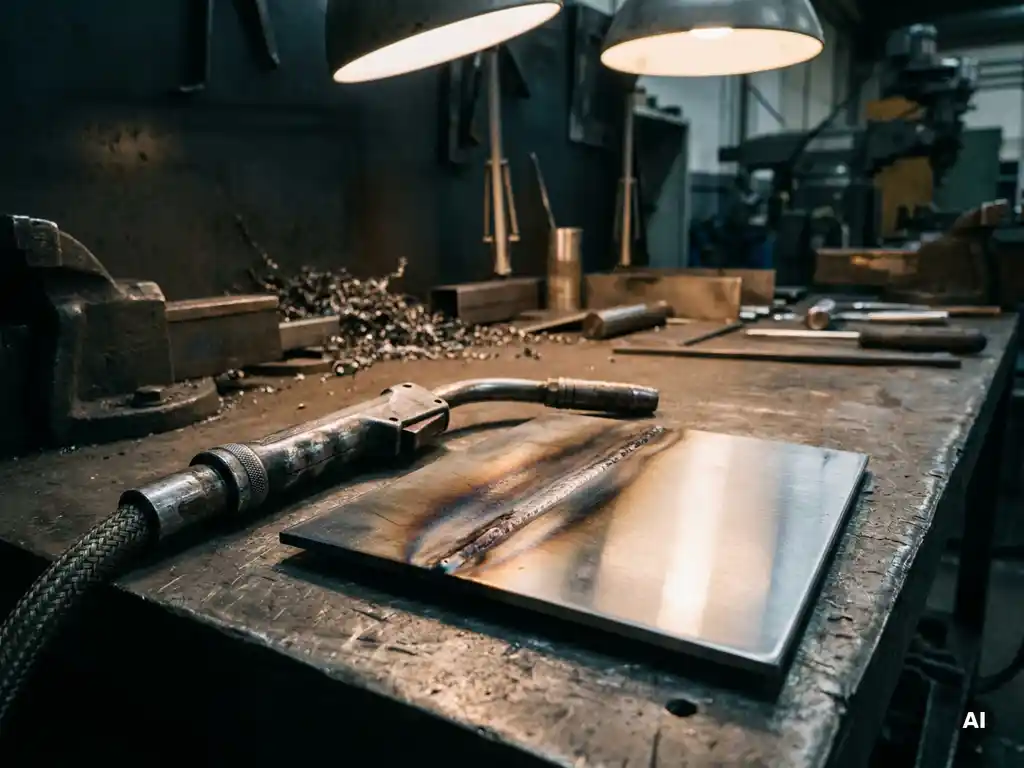
Elevated nitrogen content in steel reduces weldability by promoting embrittlement, porosity, and hardening in the heat-affected zone. Steel intended for structural welding applications typically performs best when nitrogen is kept well below 100 ppm, though the exact threshold depends on steel grade, application, and the presence of nitrogen-binding alloying elements. The sections below work through the key questions steelmakers and metallurgists face when managing nitrogen in relation to welding performance.
How does nitrogen enter steel during production?
Nitrogen enters steel primarily through contact between molten steel and atmospheric air during tapping, ladle treatment, and casting. The main sources are nitrogen dissolved from the furnace atmosphere, nitrogen introduced through alloying additions, and nitrogen picked up when the steel stream is exposed to air during transfer operations. Reoxidation events that draw in air are a particularly significant pathway for nitrogen pickup.
In electric arc furnace (EAF) steelmaking, nitrogen pickup tends to be higher than in basic oxygen furnace (BOF) routes because the arc atmosphere contains nitrogen and the process relies on scrap, which may carry surface contamination. During ladle treatment, nitrogen can be absorbed through the free surface of the melt if the slag cover is insufficient or if inert-gas shielding is not applied during open-stream transfers.
Continuous casting introduces another risk point. When the steel stream between the ladle and the tundish, or between the tundish and the mold, is exposed to air, nitrogen absorption can occur rapidly. Minimizing this exposure through ladle flow control systems and shrouding is a recognized approach to limiting nitrogen pickup at the casting stage.
What nitrogen level is considered acceptable for weldable steel?
For most structural and pressure vessel steels intended for welding, nitrogen content is generally targeted below 80 ppm (0.008%), and many specifications for high-quality weldable grades require levels at or below 50 ppm. Above these thresholds, the risk of strain-age embrittlement, porosity, and heat-affected zone hardening increases to a degree that compromises weld integrity.
The acceptable limit is not universal. It depends on the steel grade, the intended application, the presence of nitrogen-fixing elements such as aluminum or titanium, and the welding process used. Fine-grained structural steels produced to standards such as EN 10025 or ASTM A572 typically include nitrogen limits in their specifications precisely because weldability is a defined requirement.
For clean steel grades used in demanding applications such as offshore structures, pipelines, or pressure equipment, nitrogen targets are often set even lower, sometimes below 40 ppm, to ensure consistent toughness and reliable weld performance across the entire heat. In these contexts, nitrogen control is treated as part of a broader clean steel production strategy alongside oxygen and hydrogen management.
How does nitrogen affect the heat-affected zone during welding?
Nitrogen destabilizes the heat-affected zone (HAZ) by promoting the formation of hard, brittle microstructures during the thermal cycle of welding. As the HAZ heats and then rapidly cools, dissolved nitrogen that was in solid solution can precipitate as iron nitrides or interact with other elements to form coarse precipitates at grain boundaries, reducing toughness and ductility in the region immediately adjacent to the weld.
The effect is most pronounced in the coarse-grained HAZ, which experiences the highest peak temperatures and the most significant grain growth. In this zone, nitrogen in solid solution increases the tendency toward upper bainite and martensite formation, both of which are associated with reduced impact toughness. This is particularly relevant for steels welded with high heat input, where the HAZ is wider and the thermal gradient is more gradual.
Strain-age embrittlement is a related concern. When a steel with elevated nitrogen content is plastically deformed during fabrication and then subjected to moderate heating during service or post-weld heat treatment, nitrogen atoms migrate to dislocations and pin them, causing a measurable loss of toughness. This mechanism is well documented in structural steels and is one of the primary reasons nitrogen limits are written into welding-critical specifications.
What is the relationship between nitrogen and cold cracking in welds?
Nitrogen contributes to cold cracking risk primarily by increasing the hardenability of the HAZ and by raising the overall hydrogen equivalent when it interacts with the weld thermal cycle. Cold cracking, also called hydrogen-induced cracking or delayed cracking, occurs when hydrogen, residual stress, and a susceptible microstructure coincide below approximately 200 degrees Celsius. Nitrogen amplifies the susceptibility by hardening the HAZ microstructure, making it less able to accommodate the stress concentrations that drive crack initiation.
It is important to distinguish nitrogen’s role from that of hydrogen, which is the primary driver of cold cracking. Nitrogen does not cause cold cracking directly, but it creates conditions that make the steel less tolerant of the hydrogen that is inevitably present in most welding processes. A steel with low nitrogen and a well-controlled microstructure has more capacity to absorb minor hydrogen levels without cracking than a steel in which nitrogen has already pushed the HAZ toward a hard, brittle condition.
For steels with carbon equivalents already near the upper limit of weldability, the additional embrittlement effect of nitrogen can be the factor that shifts a marginal situation into an unacceptable one. This is why metallurgists working on high-strength low-alloy (HSLA) grades treat nitrogen as part of the overall weldability calculation rather than as a secondary concern.
How does nitrogen interact with other alloying elements to influence weldability?
Nitrogen’s effect on weldability is strongly modified by the presence of elements that either bind nitrogen into stable compounds or compete with it for solid-solution positions. Aluminum, titanium, and vanadium are the most relevant nitrogen-binding elements. When present in sufficient quantity, they combine with nitrogen to form fine nitride precipitates, which can actually improve HAZ toughness by pinning grain boundaries and restricting grain growth during welding.
Aluminum and nitrogen
Aluminum is the most widely used nitrogen-fixing element in steelmaking. Aluminum nitride (AlN) precipitates are effective grain refiners when they form at the right size and distribution. However, if aluminum content is insufficient relative to nitrogen, free nitrogen remains in solid solution and contributes to embrittlement. The aluminum-to-nitrogen ratio is therefore a practical parameter that steelmakers monitor when targeting good HAZ behavior.
Titanium and vanadium
Titanium forms very stable nitrides at high temperatures, making it effective at binding nitrogen before grain growth occurs in the HAZ. Vanadium nitrides and carbonitrides form at lower temperatures and contribute to precipitation strengthening, but their effect on HAZ toughness depends on the heat input and cooling rate of the welding process. In high-heat-input welding, vanadium nitrides may dissolve and reprecipitate in a coarser form that reduces toughness rather than improving it.
The practical implication is that nitrogen content cannot be evaluated in isolation. A steel with 70 ppm nitrogen and adequate aluminum may weld more reliably than a steel with 50 ppm nitrogen and no nitrogen-fixing additions, because the former has most of its nitrogen bound in benign precipitates while the latter has all of its nitrogen available to cause harm.
How can steelmakers control nitrogen to improve weld performance?
Steelmakers control nitrogen through a combination of process route selection, atmosphere management, and targeted alloy additions. The most effective interventions address nitrogen at its point of entry rather than attempting to remove it after it has been absorbed, since nitrogen removal from liquid steel is significantly more difficult than oxygen removal.
Key approaches include:
- Minimizing air contact during transfer and casting: Shrouding the steel stream between the ladle and tundish, and between the tundish and the mold, reduces the opportunity for atmospheric nitrogen absorption. Inert-gas shielding during open-stream operations is a recognized method for limiting pickup at these points.
- Optimizing furnace practice: In EAF operations, adjusting the foamy slag practice and minimizing arc-on time during the refining phase can reduce nitrogen absorption from the arc atmosphere.
- Vacuum degassing: Vacuum treatment, particularly vacuum oxygen decarburization (VOD) or Ruhrstahl-Heraeus (RH) degassing, removes dissolved nitrogen along with hydrogen. This is the most reliable method for achieving very low nitrogen levels in demanding grades.
- Nitrogen-fixing additions: Adding aluminum, titanium, or both in controlled amounts converts free nitrogen into stable nitrides, reducing the quantity available to cause HAZ embrittlement even if the total nitrogen figure remains moderate.
- Controlling ladle slag and cover: Maintaining a consistent, well-formed slag layer over the steel in the ladle limits the free surface area through which nitrogen can be absorbed during ladle treatment.
Reliable slide gate systems for ladle flow control also play a practical role in this picture. Consistent, well-controlled flow during casting reduces turbulence and the risk of air entrainment, both of which contribute to nitrogen pickup in the final product. Managing the casting process carefully is part of the same quality discipline as managing furnace and ladle practice.
How KNÖLLINGER FLO-TEC supports clean steel nitrogen control
We design and manufacture ladle slide gate systems specifically for steelworks that take clean steel production seriously. Controlling nitrogen pickup during casting depends in part on how reliably and consistently the steel stream can be managed from ladle to tundish, and our systems are built to support exactly that.
Here is what we offer for steelworks focused on nitrogen and weld quality targets:
- Inert-gas-capable slide gate systems that support shielding of the steel stream to help reduce contact with atmospheric air during casting
- Robust, enclosed designs that contribute to operational safety and consistent flow control, reducing turbulence-driven air entrainment
- Compatibility with a wide range of patent-free refractory plate formats, giving you flexibility in sourcing without compromising system performance
- Customized solutions for different ladle sizes and casting configurations, developed in close collaboration with your technical team
If your operation targets low nitrogen levels as part of a broader clean steel or weldability improvement program, we are glad to discuss how our systems can fit into your process. Contact our team to talk through your specific requirements.
Dieser Inhalt wurde mithilfe von KI erstellt und kann Fehler enthalten.