
'/%3E%3C/svg%3E)
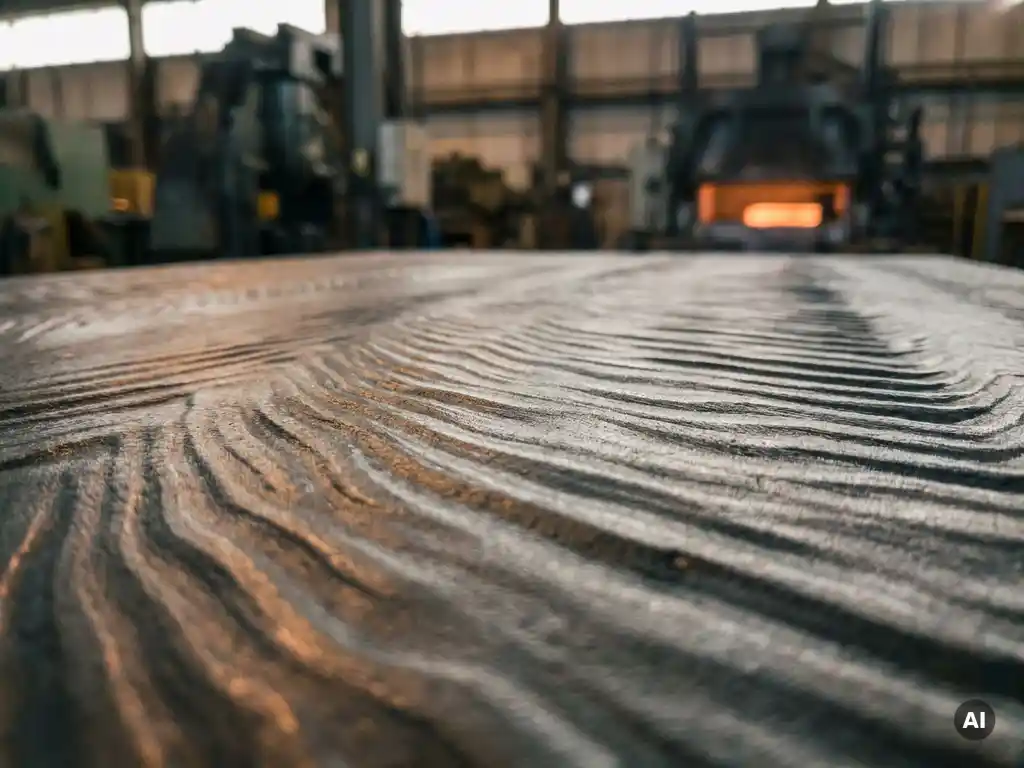
Mold oscillation settings in continuous casting directly influence slab surface quality by controlling the depth, spacing, and regularity of oscillation marks, which in turn affect the likelihood of surface cracks and other casting defects. The relationship is not incidental: parameters such as stroke amplitude, oscillation frequency, and waveform type collectively determine how the solidifying steel shell interacts with the mold wall during casting. The sections below address the most important technical questions surrounding this relationship.
What parameters define mold oscillation in continuous casting?
Mold oscillation in continuous casting is defined by four primary parameters: stroke amplitude (the total vertical displacement of the mold), oscillation frequency (the number of complete cycles per minute), the negative strip ratio (the fraction of each cycle during which the mold moves faster downward than the strand), and the waveform shape (sinusoidal or non-sinusoidal). Together, these parameters govern how the mold interacts with the solidifying steel shell and the mold flux layer between them.
Stroke amplitude typically ranges from a few millimeters to around 10 mm depending on the casting machine and steel grade. Frequency is often adjusted in relation to casting speed to maintain a consistent negative strip duration. The negative strip ratio is particularly important because it determines how effectively mold flux is drawn into the gap between the mold wall and the shell, lubricating the interface and preventing sticking. Operators who understand how these parameters interact can make targeted adjustments to reduce surface defect rates without sacrificing productivity.
How do oscillation marks form on slab surfaces?
Oscillation marks form because the mold periodically moves downward faster than the strand during the negative strip phase, causing the solidifying steel shell to fold slightly at the meniscus. Each downward stroke pushes a small ridge of steel back against the shell, creating a transverse groove on the slab surface. These grooves, spaced according to the oscillation frequency and casting speed, are the visible oscillation marks.
The depth and sharpness of these marks depend on how aggressively the mold flux lubricates the gap and how quickly the shell solidifies at the meniscus. Shallow, rounded marks are generally acceptable and expected in continuous casting. Deep, sharp-bottomed marks are problematic because they act as stress concentration points and can initiate surface cracks during or after solidification. Mold flux viscosity, casting temperature, and oscillation parameters all contribute to mark geometry.
What causes transverse cracks near oscillation marks?
Transverse cracks near oscillation marks form when tensile stresses exceed the hot strength of the steel shell at the mark root during or shortly after solidification. The mark itself creates a geometric notch, and if the steel grade has a narrow temperature window of low ductility, the thermal and mechanical stresses generated by bending, straightening, or thermal cycling can propagate a crack from that notch.
Steel grades with higher levels of certain alloying elements, particularly those that promote precipitation of fine particles at grain boundaries during the delta-ferrite to austenite transformation, are especially susceptible. In these grades, the shell at the oscillation mark root can be brittle during a specific temperature range, making crack formation more likely. Reducing mark depth through optimized oscillation settings is one of the primary strategies for managing this risk. Mold flux chemistry and casting speed adjustments complement oscillation parameter changes in a comprehensive crack-reduction approach.
How does oscillation frequency affect surface defect density?
Higher oscillation frequency reduces the pitch between oscillation marks, meaning more marks per meter of slab length, but each mark is shallower when frequency increases relative to casting speed. Lower frequency produces fewer but deeper marks. Surface defect density is therefore not simply a function of frequency alone but of the relationship between frequency, casting speed, and stroke amplitude.
In practice, increasing frequency while maintaining or increasing casting speed can reduce mark depth and lower the risk of transverse cracking, particularly for crack-sensitive steel grades. However, excessively high frequencies can reduce the effectiveness of mold flux infiltration into the mold-shell gap, which may increase friction and the risk of sticking or breakout. Finding the right frequency range requires balancing lubrication efficiency against mark geometry for each combination of steel grade and casting conditions.
What is the difference between sinusoidal and non-sinusoidal oscillation?
Sinusoidal oscillation follows a smooth, symmetric sine wave, meaning the mold accelerates and decelerates at the same rate during both the upward and downward strokes. Non-sinusoidal oscillation uses an asymmetric waveform, typically extending the upward stroke duration and compressing the downward stroke, which increases the negative strip ratio without requiring a higher frequency or larger amplitude.
The practical benefit of non-sinusoidal oscillation is greater control over the negative strip phase. By lengthening the time the mold moves upward relative to the strand, operators can improve mold flux infiltration and reduce friction during the positive strip phase, which is when the mold and strand move in the same direction. This can result in shallower oscillation marks and improved surface quality, particularly for peritectic and other crack-sensitive steel grades. Non-sinusoidal oscillation has become increasingly common in modern continuous casting machines because it offers more tuning flexibility than sinusoidal systems.
How should oscillation settings be adjusted for different steel grades?
Oscillation settings should be adjusted based on the solidification behavior, crack sensitivity, and casting speed requirements of each steel grade. Crack-sensitive grades, such as peritectic carbon steels and certain microalloyed grades, generally benefit from higher oscillation frequencies, reduced stroke amplitudes, and non-sinusoidal waveforms that minimize mark depth. Less sensitive grades allow more latitude in parameter selection.
A practical approach is to define grade-specific oscillation tables that link casting speed to frequency and amplitude, maintaining a consistent negative strip time across the speed range. When casting speed changes during a sequence, the oscillation controller adjusts frequency accordingly so that mark pitch and depth remain within acceptable limits. For high-quality steel production, these tables are validated against surface inspection data from rolled or conditioned slabs, allowing continuous refinement of the parameter sets over time.
Maintaining clean steel throughout the process is equally important. Surface defects that appear to originate from oscillation marks can sometimes be aggravated by inclusions or reoxidation products that weaken the shell at the mark root. A well-controlled ladle-to-mold flow path, including reliable flow regulation during casting, supports consistent meniscus conditions and makes oscillation parameter optimization more effective.
How KNÖLLINGER FLO-TEC supports clean steel casting
Optimizing mold oscillation settings is only one part of producing high-quality slabs. Consistent steel cleanliness from ladle to mold is equally important, and that starts with reliable, well-engineered ladle slide gate systems. We at KNÖLLINGER FLO-TEC design and manufacture slide gate systems specifically for steelworks that demand clean steel production and precise flow control during continuous casting.
- Our systems support inert-gas shielding to help reduce reoxidation between the ladle and the casting strand.
- Slide gate designs are compatible with a range of patent-free refractory plate formats, giving steelworks flexibility in refractory sourcing.
- Robust construction and enclosed design contribute to operational safety and reliable containment.
- Customized solutions are available for different ladle sizes and operating requirements.
If you are working to reduce casting defects and improve slab surface quality, reliable ladle flow control is a relevant part of the solution. Contact our team to discuss how our slide gate systems can support your casting operation, or explore our product range to learn more about what we offer. You can also download technical documentation for a closer look at our systems.
Dieser Inhalt wurde mithilfe von KI erstellt und kann Fehler enthalten.