

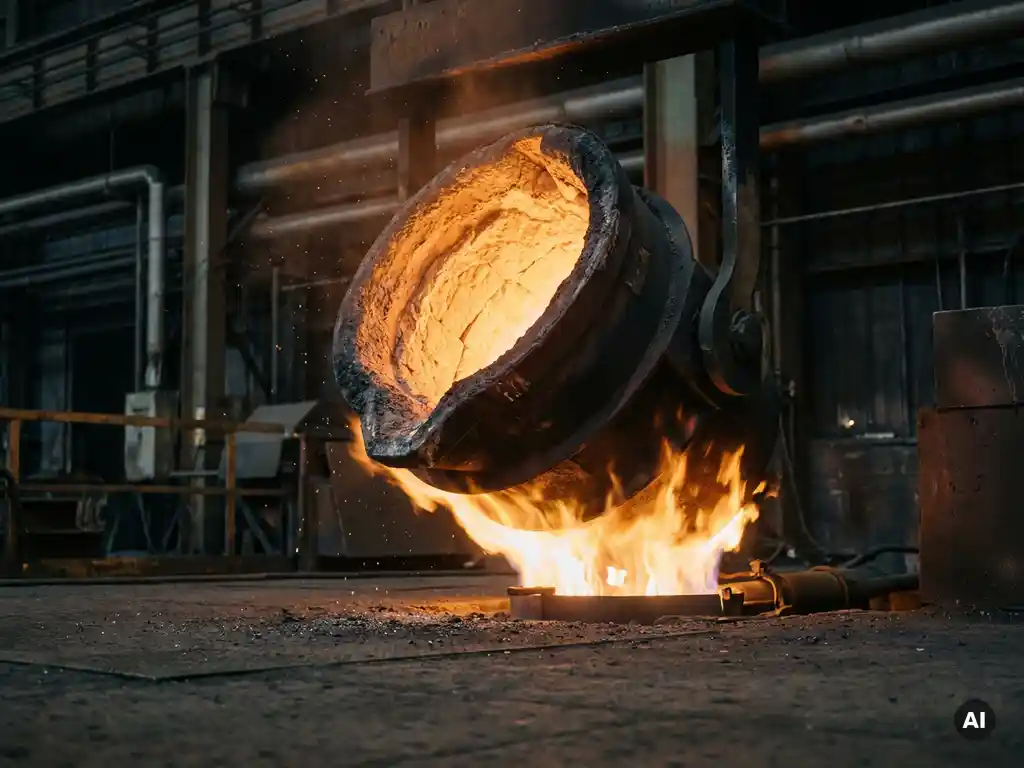
Tundish preheating directly influences steel cleanliness by controlling the thermal environment into which liquid steel first flows during continuous casting. A properly preheated tundish reduces thermal shock to refractories, minimizes moisture-driven reoxidation, and creates conditions that help non-metallic inclusions float out rather than become trapped in the solidifying steel. The sections below address the most important technical questions about tundish preheating and its role in clean steel casting.
What happens to steel cleanliness when tundish preheating is insufficient?
When tundish preheating is insufficient, residual moisture in the refractory lining converts to steam and then to hydrogen and oxygen upon contact with molten steel. This oxygen reacts with dissolved elements such as aluminum, silicon, and manganese to form non-metallic inclusions. The result is a measurable increase in inclusion content during the first minutes of casting, often referred to as the „first heat“ quality penalty.
Beyond moisture-driven reoxidation, a cold tundish causes rapid temperature loss in the steel as it enters the vessel. This accelerated cooling reduces the time available for inclusions to rise and separate from the melt before it enters the mold. Inclusions that remain suspended become trapped in the solidifying strand, creating defects that can affect surface quality, internal cleanliness, and downstream mechanical properties.
In practice, insufficient preheating also increases the risk of skull formation at the bottom of the tundish, which can disrupt flow patterns and create turbulence that re-entrains inclusions already present in the flux layer. For steel grades with tight cleanliness specifications, even a brief period of inadequate preheat can compromise an entire heat.
What temperature range is required for effective tundish preheating?
Effective tundish preheating generally requires the refractory lining to reach temperatures in the range of 1,000°C to 1,200°C before the first steel arrives. At these temperatures, residual moisture is driven off completely, the refractory mass is thermally stabilized, and the temperature gradient between the tundish shell and the incoming steel is reduced to a manageable level.
The precise target temperature depends on several factors: the thickness and composition of the refractory working lining, the mass of the tundish, the duration of the preheating cycle, and the steel grades being cast. Thicker linings and larger tundishes require longer preheat cycles to achieve uniform temperature distribution through the refractory cross-section, not just at the hot face.
Preheating too quickly can be as problematic as preheating too slowly. Rapid heating creates steep thermal gradients within the refractory, which can cause cracking and spalling. A controlled ramp rate, typically defined in the tundish preparation procedure, ensures that the lining heats evenly and arrives at the target temperature in a structurally sound condition. Monitoring the exit gas temperature from the burner system provides a practical indication of when the lining has absorbed sufficient heat.
How does tundish preheating affect non-metallic inclusion formation?
Tundish preheating temperature directly controls two of the main mechanisms behind non-metallic inclusion formation: reoxidation from moisture and inclusion flotation efficiency. A fully preheated tundish eliminates the moisture source, and its higher thermal mass slows the cooling rate of incoming steel, giving inclusions more time to rise to the slag layer before the steel exits through the submerged entry nozzle.
The relationship between temperature and inclusion behavior is well understood in ladle metallurgy and continuous casting. Alumina inclusions, which are among the most damaging to nozzle life and final product quality, form rapidly when dissolved aluminum reacts with oxygen. Any source of oxygen, whether from atmospheric exposure, refractory moisture, or oxidizing flux, accelerates this reaction. Proper preheating removes one of those oxygen sources entirely.
Inclusion size distribution also changes with preheating quality. In a cold tundish, inclusions form quickly and in large numbers during the initial pour. Many remain small and dispersed, making them harder to capture in the flux layer. In a well-preheated tundish, the inclusion formation rate is lower from the outset, and existing inclusions have more time to agglomerate into larger particles that float more readily. This produces cleaner steel with fewer fine inclusions reaching the mold.
What is the difference between oxidizing and non-oxidizing tundish preheating?
Oxidizing tundish preheating uses air-fuel burners that introduce excess oxygen into the tundish atmosphere during the heating cycle. Non-oxidizing preheating, sometimes called neutral or reducing preheating, controls the burner atmosphere to minimize free oxygen inside the tundish. The key difference is the oxidation state of the refractory hot face and the residual atmosphere present when steel first enters the vessel.
Oxidizing preheating: practical implications
Standard air-fuel burners are the most common preheating method in steelworks and are straightforward to operate. However, they leave an oxygen-rich atmosphere inside the tundish at the end of the cycle. When this atmosphere contacts the first steel, it contributes to reoxidation and inclusion formation. The effect is most pronounced in the early minutes of casting and with steel grades that contain strong deoxidants such as aluminum.
Non-oxidizing preheating: benefits for clean steel
Non-oxidizing preheating systems, which may use controlled stoichiometry burners or inert gas purging after the heating cycle, reduce the oxygen content of the tundish atmosphere before steel arrives. This approach is particularly relevant for clean steel casting, where minimizing every reoxidation source is a priority. The investment in more precise atmosphere control can translate directly into lower inclusion counts and more consistent steel quality across heats. The principle is similar to the use of inert-gas shielding in ladle slide gate systems, where reducing steel-to-oxygen contact at every stage of the casting process supports overall cleanliness targets.
How does tundish flux interact with preheating to protect steel cleanliness?
Tundish flux, applied to the steel surface after the tundish fills, absorbs non-metallic inclusions that float up from the melt. Its effectiveness depends heavily on the thermal conditions established by preheating. A well-preheated tundish allows the flux to melt and spread quickly into a uniform liquid layer, which is far more effective at capturing inclusions than a partially melted or fragmented flux cover.
When the tundish is cold at the start of casting, the steel surface temperature drops faster, slowing flux melting and leaving areas of the steel surface unprotected. During this unprotected period, the steel is exposed to atmospheric oxygen, and inclusions that reach the surface cannot be efficiently absorbed. The combination of reoxidation and poor inclusion capture creates a compounding effect on steel cleanliness.
The viscosity and basicity of the tundish flux also interact with temperature. Most flux formulations are designed to operate within a specific temperature window. If the steel temperature is too low due to inadequate preheating, the flux may not reach the viscosity needed to absorb inclusions effectively. Maintaining the correct steel temperature in the tundish, which preheating supports by reducing initial heat loss, keeps the flux in its optimal operating range throughout the casting sequence.
How can tundish preheating practice be optimized for clean steel production?
Optimizing tundish preheating for clean steel production means controlling three variables consistently: final refractory temperature, preheat duration, and the atmosphere inside the tundish at the moment steel arrives. Each variable has a direct effect on inclusion content and should be defined in a written tundish preparation procedure rather than left to individual operator judgment.
Practical steps that support optimized preheating include:
- Temperature verification: Use thermocouples or optical pyrometers to confirm that the refractory hot face has reached the target temperature before the preheat cycle ends. Visual inspection of burner flame color is not a reliable substitute for direct measurement.
- Controlled heating rate: Define and follow a ramp rate that prevents thermal shock to the lining while achieving the target temperature within the available time window. Adjust the ramp rate when using new or repaired linings.
- Atmosphere management: Where non-oxidizing preheating is not available, consider purging the tundish with inert gas immediately before the first steel arrives to displace residual oxygen from the burner atmosphere.
- Consistent preheat duration: Avoid shortening the preheat cycle under production pressure. The time saved rarely justifies the quality impact on the first heat, particularly for high-specification steel grades.
- Flux addition timing: Add tundish flux as soon as the initial steel level allows, to minimize the period during which the steel surface is exposed to the atmosphere.
Tundish preheating practice does not exist in isolation. It is one element of a broader approach to clean steel casting that includes ladle metallurgy, refractory quality, flow control, and the management of reoxidation at every transfer point in the process. For technical teams reviewing their casting process documentation, tundish preparation procedures are often a productive starting point for identifying quality improvement opportunities.
How KNÖLLINGER FLO-TEC supports clean steel casting
We develop and supply ladle slide gate systems specifically designed to support clean steel production in steelworks and continuous casting operations. Our systems address reoxidation control at the ladle-to-tundish transfer point, which is one of the most critical stages in the casting process. Here is what we offer:
- Inert-gas shielding capability: Our GT series slide gate systems can be flooded with inert gas such as argon to help reduce contact between molten steel and atmospheric oxygen during the casting sequence.
- Flexible plate format compatibility: Our systems are designed to accommodate a range of patent-free refractory plate formats, reducing dependence on individual refractory suppliers and supporting supply-chain resilience.
- Customized solutions: We develop slide gate systems to match different ladle sizes and operating requirements, including adaptations for specific casting environments.
- Operational safety: The enclosed design of our systems helps contain steel in the event of a leak, supporting safer operation in the casting bay.
If you want to discuss how our slide gate systems can contribute to your clean steel targets, contact our team directly. We are happy to review your current setup and identify where our solutions can add practical value.