

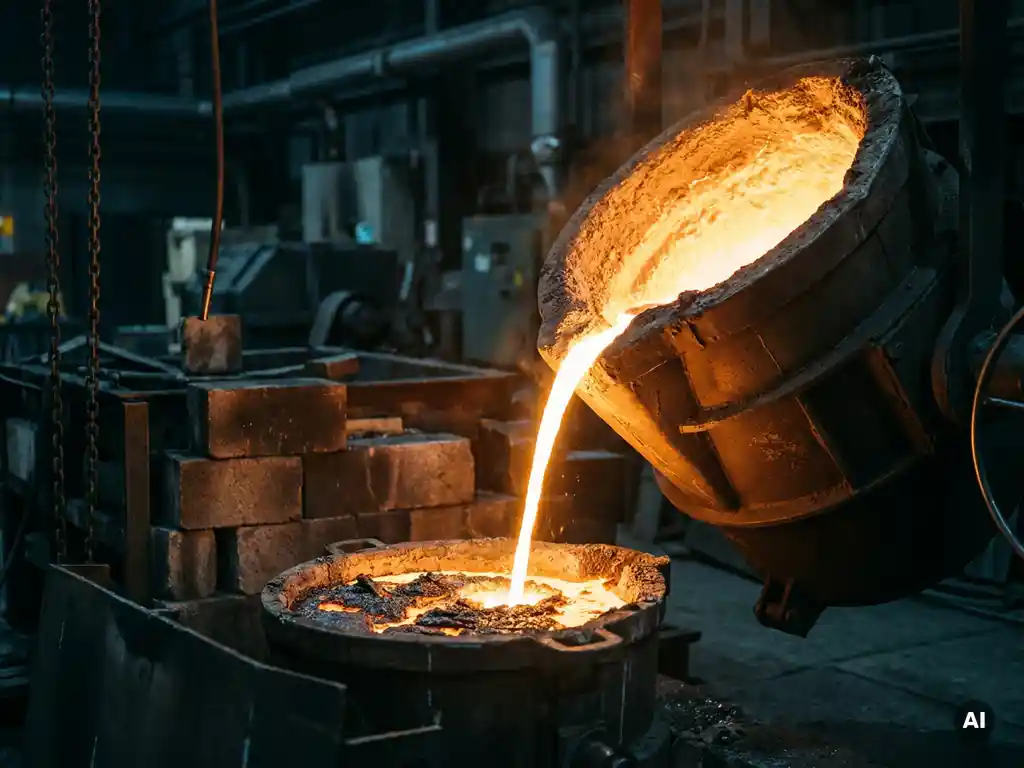
Desulfurization plays a central role in clean steel production by reducing sulfur content to levels that prevent the formation of harmful inclusions and preserve the mechanical integrity of the finished steel. Elevated sulfur concentrations cause embrittlement, reduce ductility, and compromise weld quality, making sulfur control one of the most important metallurgical steps for producers targeting high-specification steel grades. The sections below address the key questions around sulfur removal, the methods used in ladle metallurgy, and the practical challenges steelworks face in achieving consistent results.
How does sulfur affect the mechanical properties of steel?
Sulfur reduces the toughness, ductility, and weld integrity of steel by forming manganese sulfide (MnS) inclusions that act as stress concentration points within the microstructure. These inclusions are elongated during rolling, creating directional weaknesses that make the steel prone to cracking under transverse loading. For structural, pipeline, automotive, and pressure vessel grades, elevated sulfur content is a serious quality risk.
In practice, MnS inclusions impair impact toughness, particularly at low temperatures, which is a critical concern for offshore structures, cryogenic applications, and Arctic-rated pipelines. Even at moderate sulfur levels, the anisotropy introduced by stringer-shaped inclusions can cause significant differences in mechanical performance depending on the orientation of loading relative to the rolling direction. For steel grades that must meet tight Charpy impact requirements or fracture toughness specifications, sulfur is one of the first elements that metallurgists target for reduction.
How does the desulfurization process work in steelmaking?
The steel desulfurization process works by transferring sulfur from liquid steel into a slag phase that has a high affinity for sulfur. This transfer depends on three conditions being met simultaneously: a slag with high basicity and sufficiently FeO-free composition, a low oxygen activity in the steel, and adequate mixing between steel and slag to drive the reaction to completion.
Sulfur behaves as an acidic element in metallurgical terms, so it migrates preferentially into basic slags rich in CaO. For the reaction to proceed efficiently, the oxygen potential in the steel must be kept low, which is why desulfurization is typically carried out after deoxidation. Once aluminum or silicon has removed dissolved oxygen, the thermodynamic conditions become favorable for sulfur partitioning into the slag. Stirring, usually achieved through argon purging from the ladle bottom, increases the contact area between steel and slag and accelerates the mass transfer of sulfur out of the melt.
What methods are used to desulfurize steel in the ladle?
The main methods used to desulfurize steel in the ladle are slag treatment with synthetic lime-based slags, calcium wire injection, and powder injection of desulfurizing agents such as calcium carbide or magnesium blends. Each method suits different production volumes, target sulfur levels, and existing equipment configurations.
Ladle furnace (LF) treatment is the most widely used approach in modern steelworks. A synthetic slag with high CaO and low SiO2 content is built up in the ladle, and the steel is heated and stirred while sulfur partitions into the slag. This method allows precise temperature control alongside desulfurization, which is valuable when the process needs to meet tight casting temperature windows.
For ultra-low sulfur grades, calcium wire injection complements slag treatment by modifying residual sulfide inclusions and improving their morphology. Powder injection systems that deliver desulfurizing reagents directly into the steel through submerged lances offer high efficiency, particularly when treating large heats or when very short treatment cycles are required. The choice of method depends on target sulfur levels, heat size, cycle time, and the downstream casting process.
What sulfur levels are required for clean steel grades?
Clean steel grades typically require sulfur content below 50 ppm (0.005%), and demanding applications such as pipeline steels, bearing steels, and heavy plate for offshore use often specify sulfur below 10 ppm (0.001%). Standard commercial grades may tolerate up to 150 ppm, but any steel marketed as a clean or high-performance grade will have strict sulfur upper limits defined in the product specification.
Pipeline steels produced to grades such as X65 or X70 commonly carry sulfur specifications at or below 20 ppm to ensure resistance to hydrogen-induced cracking (HIC) in sour service environments. Bearing steels for automotive and industrial applications target similarly low levels to minimize the number and size of inclusions that could act as fatigue initiation sites. Heavy structural plate for pressure vessels and offshore platforms often specifies sulfur below 30 ppm to ensure consistent through-thickness toughness.
These targets make desulfurization in the ladle a non-negotiable step in the production route for any steelworks aiming to compete in high-value market segments. Achieving and consistently holding these levels requires reliable ladle metallurgy equipment and well-controlled process conditions throughout secondary refining and ladle flow control.
How does desulfurization interact with other clean steel refining steps?
Desulfurization is closely linked to deoxidation, inclusion modification, and reoxidation prevention because each step affects the thermodynamic and physical conditions that determine the final cleanliness of the steel. Performing these steps in the correct sequence and maintaining the right conditions between them is what separates truly clean steel from steel that simply meets a chemical composition specification.
Deoxidation must precede effective desulfurization because high oxygen activity competes with sulfur for the available calcium and suppresses the sulfur partition ratio into slag. Once deoxidation is complete and the oxygen activity is low, the ladle furnace treatment can achieve the sulfur reduction targets efficiently. After desulfurization, calcium treatment is often applied to modify any remaining oxide and sulfide inclusions into globular forms that are less damaging to mechanical properties.
Reoxidation is the critical threat that can undo the work of both deoxidation and desulfurization. If the steel picks up oxygen during tapping, transfer, or casting, new oxide inclusions form and the inclusion count rises again. This is why protecting the steel from atmospheric contact throughout the process, including at the ladle outlet during casting, directly supports the goals of the desulfurization step. Inert-gas shielding at the ladle slide gate is one measure that helps reduce reoxidation during the transfer of steel from ladle to tundish.
What are the main challenges in achieving consistent desulfurization results?
The main challenges in achieving consistent desulfurization results are maintaining stable slag chemistry across heats, controlling reoxidation between ladle treatment and casting, managing heat losses during extended treatment cycles, and ensuring uniform stirring without causing excessive slag entrainment.
Slag composition variability is a persistent difficulty. The incoming slag from the converter or electric arc furnace may carry high FeO or SiO2 content that reduces desulfurization efficiency unless the slag is adequately conditioned before treatment begins. Inconsistent raw material quality, varying tap temperatures, and differences in deoxidation practice all contribute to heat-to-heat variation in the starting conditions for desulfurization.
Stirring intensity is another balancing act. Sufficient argon flow is needed to promote steel-slag contact and drive sulfur transfer, but excessive stirring causes slag emulsification and can introduce slag droplets back into the steel, increasing the inclusion count. Finding the right stirring regime for each ladle size and slag volume requires careful process development and consistent equipment performance.
Reoxidation between the end of ladle treatment and the point of casting remains a significant source of inconsistency. Even a well-desulfurized heat can arrive at the tundish with elevated oxygen levels if the steel has been exposed to air during ladle transfer or through a poorly sealed ladle outlet. Reliable slide gate systems that support inert-gas shielding and maintain consistent flow control help reduce this risk, and slide gate solutions designed for clean steel applications address exactly this vulnerability in the production route.
How KNÖLLINGER FLO-TEC supports clean steel production
We develop and manufacture ladle slide gate systems specifically for steelworks that set high standards for steel cleanliness and process reliability. Our systems are designed to support the goals of secondary metallurgy, including the desulfurization steps described above, by helping to protect the steel from reoxidation during casting and by providing consistent, controllable flow from ladle to tundish.
- Slide gate systems designed to support inert-gas shielding, helping reduce contact between molten steel and oxygen during casting
- Robust construction suited to the demanding thermal and mechanical conditions of ladle metallurgy
- Compatibility with a wide range of patent-free refractory plate formats, reducing dependence on individual refractory suppliers
- Customized solutions for different ladle sizes and operating requirements, including both continuous casting and ingot casting applications
- Enclosed design that can improve operational safety by helping contain steel in the event of a leak
If you produce clean steel grades and want to discuss how your ladle slide gate setup supports your desulfurization and reoxidation control objectives, we are ready to help. Contact our team to talk through your specific requirements.