

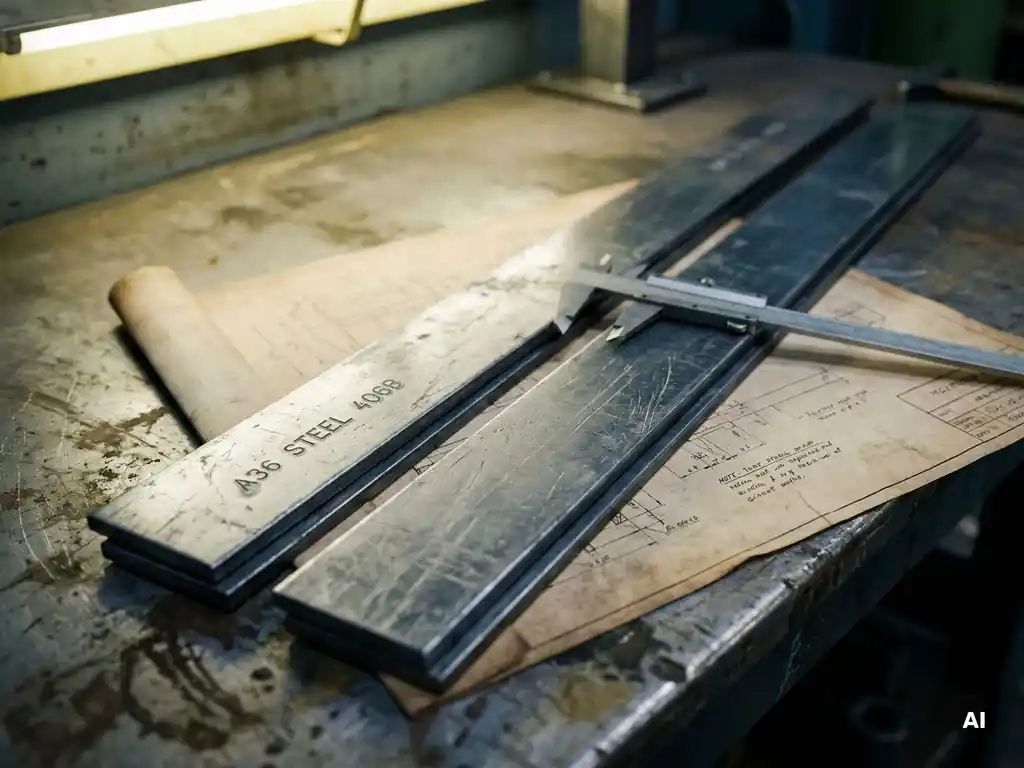
A steel grade and a steel specification are related but distinct concepts. A steel grade is a shorthand label that identifies a steel’s chemical composition and, in many systems, its mechanical properties. A steel specification is the broader technical document that defines the requirements a steel product must meet, including testing methods, tolerances, and permitted variations. The grade sits inside the specification, not the other way around.
Understanding the difference matters in practice because two steelworks can order the „same“ grade and receive products governed by different specifications, leading to real differences in quality, testing requirements, and end-use suitability. The sections below work through the most common questions on this topic in order of increasing complexity.
How does a steel grade get assigned?
A steel grade is assigned by a standards body, a national authority, or a producer based on the steel’s defined chemical composition and, in many classification systems, its minimum mechanical properties. The grade designation is a compact identifier, a code, number, or letter combination, that communicates what the steel is made of and what performance class it belongs to.
Different standardization systems use different approaches to grade assignment. European standards under the EN system, for example, assign grades based on a combination of yield strength class and chemical composition group. American standards such as ASTM and SAE/AISI use numerical codes that map to specific compositional ranges. In both cases, the grade tells you what the steel contains and, in structural or tool steel grades, what mechanical behavior to expect at minimum.
Producers can also assign proprietary grade designations for in-house products, but these must still be mapped to a recognized specification before the steel can be sold or used in regulated applications. In ladle metallurgy and clean steel production, knowing the precise grade is important because even small compositional differences affect how steel behaves during casting, solidification, and downstream processing.
What exactly is a steel specification?
A steel specification is a formal technical document that sets out all the requirements a steel product must satisfy to be accepted for a particular application or market. It covers permitted chemical composition ranges, required mechanical properties, permissible manufacturing methods, inspection and testing procedures, dimensional tolerances, surface condition requirements, and documentation obligations.
Specifications are published by standards organizations such as ASTM International, DIN, EN, BS, or ISO, and they may also be issued by individual customers as proprietary or supplementary documents. A specification can cover a single grade or a whole family of grades. For example, a single ASTM specification for structural steel plate may list several grades, each with a different yield strength class, all governed by the same testing and inspection framework.
The specification is the legal and contractual foundation of a steel order. When a steelwork or end user places an order, they reference the specification, not just the grade, to ensure that the product will be tested, documented, and certified in a consistent, verifiable way. This is particularly relevant in demanding applications such as pressure vessels, structural components, and high-alloy steel for continuous casting, where process control and steel cleanliness directly affect product integrity.
What’s the difference between steel grade and steel specification?
The key difference between a steel grade and a steel specification is their scope. A grade defines what the steel is, its composition and performance class. A specification defines what must be done to verify and document that the steel meets those requirements. The grade is the target; the specification is the rulebook for confirming the target has been reached.
Think of it this way: a grade tells you the destination, and the specification tells you how the journey must be made and proven. Two steels can share the same grade designation but be produced and tested under different specifications, meaning they may differ in testing frequency, permitted heat treatment, documentation depth, or dimensional tolerances, even if their nominal composition is identical.
In practical steelmaking terms, this distinction affects purchasing, quality assurance, and traceability. A plant manager ordering steel for a critical application needs to specify both the grade and the governing specification to ensure the product delivered is genuinely fit for purpose. Referencing only the grade leaves room for variation that may be acceptable in general applications but problematic in high-demand environments.
Can two steel grades share the same specification?
Yes. It is common for a single specification to include multiple grades. In this case, the specification sets the overarching framework, testing methods, inspection requirements, documentation standards, while each grade within it defines a specific compositional or strength class. Ordering steel requires you to cite both the specification and the grade to be unambiguous.
A well-known example is ASTM A36 versus A572 Grade 50: both fall under structural steel specifications, but they differ in yield strength requirements and compositional limits. Each grade is a distinct product, yet both are governed by specifications that share common testing and certification logic. This structure allows manufacturers and buyers to work within a consistent quality framework while still selecting the specific material properties they need.
In metallurgy, this layered system also supports cross-referencing and substitution. When a particular grade is unavailable, procurement teams can identify an alternative grade within the same or a comparable specification that meets the required properties. For steelworks focused on ladle flow control and consistent cast quality, understanding which grades are interchangeable within a specification helps maintain production continuity without compromising steel quality standards.
When does grade matter more than specification, or vice versa?
Grade matters more when the focus is on material properties and process compatibility, for example, when a metallurgist is selecting steel for a specific casting sequence, alloying target, or end-use performance requirement. Specification matters more when the focus is on compliance, traceability, and contractual assurance, for example, when certifying steel for a regulated application or auditing a supply chain.
In day-to-day steelmaking, both matter simultaneously, but they come to the foreground at different points in the production and procurement cycle.
- Grade is the priority during process design, alloying decisions, and quality planning: the metallurgist needs to know what the steel must be.
- Specification is the priority during procurement, incoming inspection, and customer certification: the quality manager needs to know how compliance will be demonstrated and documented.
- Both are equally important in regulated sectors such as pressure equipment, automotive, aerospace supply chains, and structural engineering, where a product can be rejected if either the grade or the governing specification does not match the order requirements.
In clean steel production environments, where the goal is to minimize inclusions, control reoxidation, and achieve precise compositional targets, the grade defines the metallurgical aim and the specification defines the verification standard. Neither can substitute for the other.
How do cross-standard grade equivalents affect specifications?
Cross-standard grade equivalents, such as the commonly used tables mapping EN grades to ASTM or DIN grades, indicate that two grades from different national or international standards have similar or overlapping chemical and mechanical properties. However, equivalence in composition does not mean equivalence in specification requirements. The testing methods, inspection frequencies, documentation formats, and permitted tolerances may differ significantly between standards.
This is a practical issue for international steel supply chains. A European steelwork supplying material to a customer in the United States, Turkey, or the Middle East may need to demonstrate compliance with both the local specification and the customer’s preferred standard. Simply citing a compositional equivalent is not sufficient if the governing specification requires different certification documents, different test frequencies, or different heat treatment records.
For procurement and quality teams, the safest approach is to treat cross-standard equivalents as a starting point for technical comparison, not as a direct substitution. When ordering steel internationally, always confirm which specification governs the order, which testing regime applies, and which certification documents will be provided. This avoids disputes at incoming inspection and ensures the material is genuinely fit for its intended use, whether in structural applications, pressure-containing components, or demanding metallurgical processes such as continuous casting.
How KNÖLLINGER FLO-TEC supports steel grade and specification requirements in practice
When a steelwork produces multiple steel grades under different specifications, the demands on ladle equipment change with every casting sequence. Slide gate systems need to perform reliably across varying steel temperatures, compositions, and flow requirements, and any inconsistency in flow control or reoxidation risk directly affects whether the cast product meets its grade and specification targets.
We design and manufacture ladle slide gate systems specifically for steelworks that take steel quality seriously. Our systems support clean steel production in the following practical ways:
- Inert-gas shielding capability to help reduce contact between molten steel and oxygen during casting, supporting cleanliness targets across different steel grades
- Compatibility with a wide range of patent-free refractory plate formats, giving steelworks flexibility to source plates independently and reduce supply-chain dependence
- Systems adaptable to different ladle sizes and operating conditions, including solutions for both continuous casting and ingot casting
- Enclosed design that supports operational safety and helps contain steel in the event of a leak
- Customized configurations for steelworks with specific grade portfolios or demanding specification requirements
If you produce quality steel and want to discuss how your ladle equipment can better support your grade and specification requirements, contact our team for a technical conversation. You can also explore our product range or download technical documentation to learn more about our systems.
Dieser Inhalt wurde mithilfe von KI erstellt und kann Fehler enthalten.