

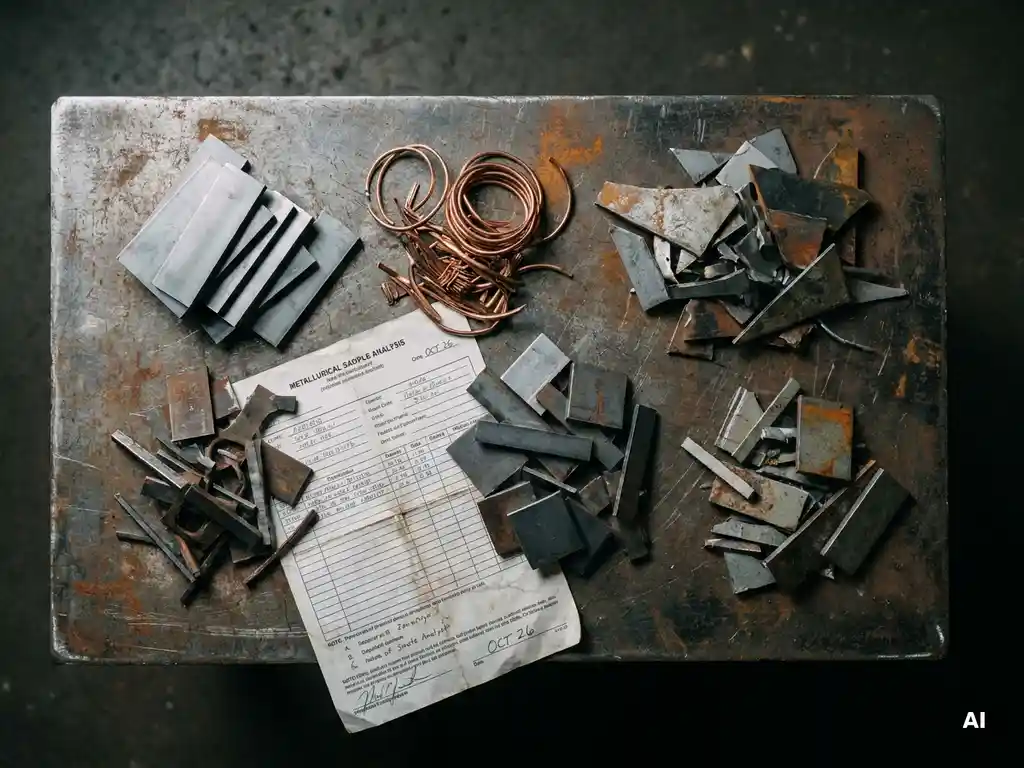
Scrap selection directly determines how many residual elements enter an electric arc furnace heat, because the charge mix is the primary source of tramp elements such as copper, tin, nickel, and chromium. Unlike impurities introduced through fluxes or electrodes, tramp elements arrive embedded in the metallic charge itself and cannot be removed once they dissolve into the melt. Steelmakers working to defined quality specifications must therefore treat scrap grading and sourcing as a front-line quality control decision, not a procurement afterthought. The sections below address the most common technical questions around tramp element accumulation, scrap source risk, and charge mix strategies in EAF steelmaking.
Which tramp elements accumulate most in EAF heats?
Copper, tin, nickel, chromium, and molybdenum are the tramp elements that accumulate most persistently in electric arc furnace heats. Of these, copper and tin attract the most attention because they are both common in obsolete scrap and harmful to surface quality and hot workability even at relatively low concentrations. Nickel, chromium, and molybdenum accumulate more slowly but still build up over time in shops that recycle heavily contaminated grades.
These elements share a critical characteristic: they are more noble than iron, meaning they are not oxidized and removed during the conventional EAF oxidizing refining period. While carbon, phosphorus, and sulfur can be partially controlled through slag chemistry and oxygen injection, copper and tin remain dissolved in the steel regardless of what happens in the furnace. Every heat that uses contaminated scrap adds incrementally to the residual element burden in the shop’s melt cycle.
Tin deserves particular attention because it segregates strongly to grain boundaries during solidification and hot rolling, causing surface cracking and embrittlement at concentrations as low as 0.02 percent by weight. Copper begins to cause hot shortness above roughly 0.15 to 0.20 percent, especially when tin is also present. Their combined effect is significantly more damaging than either element acting alone.
How does scrap grade determine residual element input?
Scrap grade is the single most reliable predictor of residual element input into an EAF heat. Higher-grade scrap categories, such as prompt industrial scrap and new production offcuts, carry minimal tramp element contamination because they originate from known, controlled manufacturing processes. Lower-grade obsolete scrap, collected from end-of-life products, contains unpredictable mixtures of alloyed and coated materials that introduce significant copper, tin, and other residuals.
Scrap grading systems used across Europe and North America classify material according to source, size, and expected chemistry. Grades derived from automotive stampings, appliance scrap, and mixed demolition material consistently show higher copper and tin levels than grades sourced from steel plant home scrap or industrial offcuts. The chemistry of each grade is not fixed, however. It varies with the composition of the collected material, the effectiveness of sorting, and the presence of attached non-ferrous components that visual inspection may not catch.
For EAF operators targeting clean steel specifications, the practical implication is straightforward: the lower the scrap grade, the more conservative the charge fraction must be, and the more carefully residual element inputs must be modelled before tapping. Relying on average grade chemistry without accounting for batch-to-batch variation is a common source of unexpected tramp element exceedances.
What scrap sources carry the highest copper and tin contamination?
Automotive scrap, electrical and electronic waste, and mixed demolition scrap consistently carry the highest copper and tin contamination of all common scrap sources. Automotive shredder residue and shredded obsolete scrap are particularly problematic because the shredding process does not separate copper wiring, motor windings, and tin-coated steel components from the ferrous fraction with sufficient reliability.
Copper contamination in automotive scrap originates primarily from wiring harnesses, electric motors, and copper-brazed components that are difficult to remove mechanically before shredding. As vehicle electrification increases, the copper content embedded in end-of-life vehicles continues to rise, making automotive scrap progressively more challenging for EAF operators focused on low-copper specifications.
Tin contamination comes largely from tin-coated steel packaging, such as food cans and industrial containers, and from tin-based solders used in electronics. Galvanized steel carries zinc rather than tin, but it is often mixed with tin-coated material in baled obsolete scrap, complicating sorting. Prompt manufacturing scrap from tinplate producers is a known high-tin source if not carefully segregated.
By contrast, home scrap generated within a steelworks, along with prompt industrial offcuts from automotive stamping plants and pipe and tube manufacturers, carries very low residual element levels because its origin and composition are tightly controlled. Many EAF operators use these premium sources as a dilution tool when blending higher-risk grades into the charge.
How do steelmakers control tramp element levels through charge mix design?
Steelmakers control tramp element levels in EAF heats primarily by calculating the weighted average residual element input from each scrap category in the planned charge and adjusting proportions to stay within target chemistry limits before tapping. This process, known as charge mix design or burden calculation, treats each scrap grade as a raw material with a defined residual element profile and blends grades to achieve a predictable melt composition.
The practical steps involved in effective charge mix design include the following:
- Maintaining a current chemistry database for each scrap grade and supplier, updated regularly from sampling and spectrometric analysis
- Setting conservative upper limits for copper and tin inputs per heat, with a margin below the finished steel specification to allow for measurement uncertainty
- Using low-residual dilution materials, such as direct reduced iron, hot briquetted iron, or high-quality home scrap, to reduce the average residual content when higher-risk grades must be used
- Tracking cumulative residual element trends across multiple heats to detect supplier drift or sorting failures before they cause product rejections
- Applying tighter blend restrictions when rolling schedules require surface-critical or deep-drawing grades with low copper and tin tolerances
Charge mix design is most effective when it is integrated with production planning rather than treated as a last-minute adjustment. Shops that schedule scrap procurement and heat sequencing together, aligning higher-risk scrap use with product grades that tolerate more residuals, achieve better overall yield from their scrap inventory without compromising quality on sensitive grades.
Why can’t tramp elements be removed during EAF refining?
Tramp elements such as copper and tin cannot be removed during EAF refining because they are thermodynamically more stable than iron in the metallic state under the oxidizing conditions used in the furnace. The refining process works by selectively oxidizing elements that have a stronger affinity for oxygen than iron does, transferring them into the slag. Copper and tin do not oxidize under practical steelmaking conditions, so they remain dissolved in the liquid steel throughout the heat.
This thermodynamic constraint is fundamental and cannot be overcome by adjusting slag basicity, increasing oxygen injection, or extending the refining period. Processes that can remove copper from steel, such as selective volatilization under vacuum or chlorination, exist at a laboratory scale but are not commercially viable for bulk steelmaking. The industry has no practical in-furnace remedy once copper or tin has entered the melt.
The same logic applies to nickel, molybdenum, and, to a lesser extent, chromium, though chromium can be partially oxidized into the slag under highly oxidizing conditions. Tin is slightly more volatile than copper and may show marginal losses at very high temperatures, but not at levels that meaningfully reduce its concentration in the steel.
This irreversibility is the core reason why scrap selection and charge mix design are the only effective control points for tramp element management in EAF steelmaking. Once the charge is melted, the metallurgist’s options are limited to dilution with clean additions or downgrading the heat to a product specification that tolerates the residual level present.
What tramp element thresholds matter for common steel product grades?
The tramp element thresholds that matter most depend on the product grade, but copper below 0.10 percent and tin below 0.02 percent are widely used as conservative targets for surface-critical and formability-sensitive applications. Deep-drawing steels, exposed automotive panel grades, and cold-rolled sheet for appliance applications are among the most demanding, while structural sections, reinforcing bar, and wire rod for non-critical applications tolerate significantly higher residual levels.
Broadly, common threshold ranges by product category include:
- Cold-rolled sheet and exposed automotive grades: copper typically below 0.06 to 0.10 percent, tin below 0.015 to 0.020 percent
- Hot-rolled structural sections and plate: copper below 0.20 to 0.30 percent is generally acceptable, tin below 0.040 percent
- Reinforcing bar and merchant bar: copper up to 0.40 percent is often tolerated, with tin limits less strictly enforced in many specifications
- Wire rod for cold heading and spring applications: copper below 0.10 to 0.15 percent, tin limits vary but surface quality requirements drive conservative targets
- Pipe and tube for pressure applications: copper and tin limits depend on the applicable standard and inspection regime, but surface quality requirements are typically strict
The interaction between copper and tin is an important practical consideration. A steel with 0.15 percent copper and 0.025 percent tin may show surface defects during hot rolling that would not appear if either element were present alone at those concentrations. Many quality-focused EAF shops therefore apply combined residual element limits rather than relying on single-element thresholds in isolation.
Nickel and chromium, while also classified as tramp elements in EAF steelmaking, are tolerated at considerably higher levels in most carbon steel grades and can even be beneficial in certain structural applications. They become problematic primarily in grades where tight hardenability control is required or where their presence interferes with downstream processing such as galvanizing or coating adhesion.
How KNÖLLINGER FLO-TEC supports clean steel production at the ladle stage
Managing tramp elements through careful scrap selection is the upstream half of clean steel production. The downstream half depends equally on what happens between the EAF tap and the caster. Reoxidation at the ladle, during transfer, and at the tundish can undo the chemistry work done in the furnace, introducing oxide inclusions that affect mechanical properties and surface quality in the same grades where tramp element control matters most.
We at KNÖLLINGER FLO-TEC specialize in ladle slide gate systems designed to support clean steel production at this critical stage. Our systems are built for steelworks where quality requirements are demanding and operational reliability cannot be compromised. Relevant capabilities include:
- Slide gate systems designed to reduce reoxidation during casting, supporting the clean steel targets set upstream in the EAF and ladle furnace
- Inert-gas shielding capability in our GT series, allowing the system to be flooded with argon to help minimize steel-air contact during the casting sequence
- Compatibility with a wide range of patent-free refractory plate formats, giving steelworks flexibility in refractory sourcing and reducing dependence on a single supplier
- Robust, enclosed construction designed with operational safety in mind, including reliable containment behavior in the event of a steel leak
- Customized solutions for different ladle sizes and operating requirements, developed in close collaboration with the customer’s technical team
If you are responsible for steel quality, ladle operations, or refractory purchasing at a steelworks and want to discuss how our ladle slide gate systems can support your clean steel targets, we welcome the conversation. Visit our contact page to get in touch with our team directly.
Dieser Inhalt wurde mithilfe von KI erstellt und kann Fehler enthalten.