

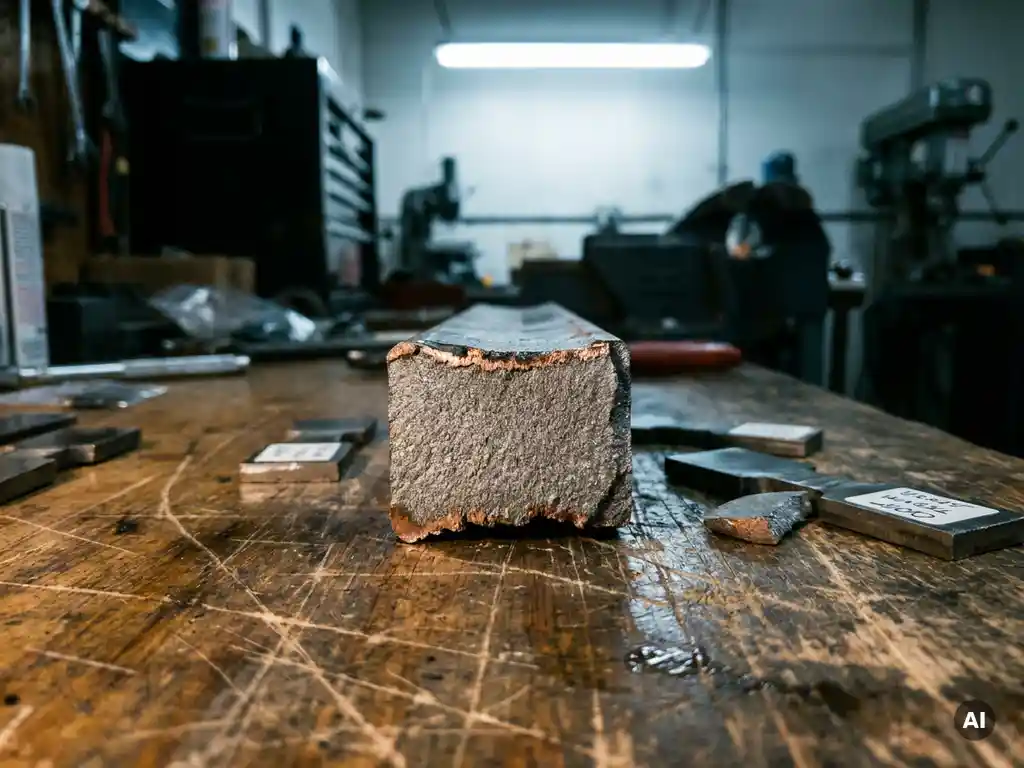
When residual copper in steel exceeds grade-specific limits, it degrades hot ductility, promotes surface cracking during hot rolling, and can cause brittle fracture in finished products. The most serious consequence is hot shortness, a condition where copper-rich phases form at grain boundaries and cause surface tearing at rolling temperatures. This article works through the key questions steelmakers and metallurgists face when managing copper as a tramp element.
How does copper accumulate in steel during production?
Copper accumulates in steel primarily through scrap-based melting. Unlike most alloying elements, copper is not removed by conventional steelmaking oxidation processes, so every charge that contains copper-bearing scrap adds to the residual copper level in the final product. Once copper enters the melt, it stays there.
The main sources of copper contamination in steel include electrical motors, copper-wound transformers, wiring harnesses in automotive scrap, plumbing fittings, and coated sheet steel where copper is present in coatings or attached components. As electric arc furnace (EAF) steelmaking relies increasingly on recycled scrap rather than virgin iron, the cumulative buildup of copper across successive melting cycles has become a growing concern for steel quality managers.
In basic oxygen furnace (BOF) steelmaking, dilution with hot metal from the blast furnace keeps copper levels low. EAF producers working with mixed or poorly sorted scrap face the greater challenge, because there is no equivalent dilution mechanism. Copper concentrations that appear modest in any single heat can drift upward over time if scrap selection is not actively managed.
What are the accepted copper limits in steel grades?
Accepted copper limits in steel vary by grade and application, but most structural and flat-rolled carbon steels specify a maximum of 0.20 to 0.35 percent copper by weight. For demanding applications such as deep-drawing steels, pipeline grades, or high-strength low-alloy (HSLA) steels, limits are often tighter, typically below 0.10 percent.
Standards bodies and customer specifications define these thresholds based on the sensitivity of the end application to surface quality and mechanical consistency. Wire rod, thin-gauge strip, and cold-rolled sheet are particularly sensitive because surface defects introduced during hot rolling are difficult to remove and may propagate during further processing.
Some specialty grades, including certain weathering steels such as Cor-Ten types, deliberately add copper as an alloying element at levels of 0.25 to 0.40 percent to promote atmospheric corrosion resistance. In those cases, copper is intentional and controlled. The concern addressed here is unintentional residual copper that was never part of the design specification.
What mechanical properties deteriorate when copper exceeds limits?
When residual copper in steel exceeds grade limits, the most significant mechanical effects are reduced hot ductility, increased susceptibility to surface cracking, and, in some conditions, reduced toughness in the finished product. These effects are most pronounced during thermomechanical processing rather than in the final cold state.
At elevated temperatures, excess copper reduces the plasticity of the steel surface layer, making it prone to tearing under the tensile stresses generated during rolling or forging. In the finished product, elevated copper can also contribute to:
- Reduced Charpy impact toughness, particularly at lower test temperatures
- Increased hardness in the near-surface zone due to copper enrichment
- Degraded surface finish, which affects fatigue performance in cyclically loaded components
- Reduced weldability in grades where copper interacts with other residuals such as tin or arsenic
The interaction between copper and other tramp elements matters. Copper acting alone at moderate levels is less damaging than copper combined with tin, which significantly lowers the melting point of the copper-rich phase and intensifies hot shortness. Metallurgists evaluating steel quality should assess residual elements together rather than in isolation.
Why does copper cause hot shortness during hot rolling?
Copper causes hot shortness because it is selectively oxidized out of the steel surface during reheating, creating a liquid copper-rich film at the austenite grain boundaries. This film has a melting point well below typical hot rolling temperatures, and when rolling forces are applied, the grain boundary liquid causes the surface to tear rather than deform plastically.
The mechanism works as follows: during furnace reheating above approximately 1100 degrees Celsius, iron in the surface layer oxidizes preferentially into the scale, while copper, which is more noble than iron, does not oxidize and instead concentrates in a thin layer beneath the scale. If the copper content in this enriched layer reaches a critical threshold, it forms a low-melting liquid phase. Rolling then drives this liquid into grain boundaries under compressive and tensile stress, causing intergranular cracking visible as surface scabs, laps, or transverse cracks.
The severity of hot shortness depends on reheating temperature, furnace atmosphere, rolling reduction schedule, and the combined level of copper with other low-melting residuals. Higher reheating temperatures and oxidizing furnace conditions tend to worsen the effect by accelerating copper enrichment at the surface.
How does nickel mitigate copper-induced hot shortness?
Nickel mitigates copper-induced hot shortness by raising the melting point of the copper-rich surface phase, preventing it from becoming liquid at normal hot rolling temperatures. A nickel addition of roughly half the copper content by weight is generally considered sufficient to suppress the formation of a liquid grain boundary film under standard reheating conditions.
Nickel achieves this by dissolving into the copper-rich layer and shifting its solidus temperature upward. When the copper-nickel phase remains solid at rolling temperature, it no longer penetrates grain boundaries as a liquid, and the steel surface retains adequate ductility during deformation. This is why some specifications for EAF-produced steel require a minimum nickel-to-copper ratio rather than simply capping copper alone.
However, nickel addition has a cost, and it is not always practical or economically justified for commodity grades. Where nickel is not added, steelmakers must rely on strict scrap control, adjusted reheating practices such as shorter soaking times or slightly reduced peak temperatures, and surface conditioning after rolling to manage the consequences of copper contamination.
When should steelmakers reject or blend scrap to control copper?
Steelmakers should reject or blend scrap when incoming material analysis indicates that using it without dilution would push the heat copper level above the target specification for the grade being produced. The decision threshold depends on the planned product mix, the available dilution sources, and the tolerance for rework or downgrading.
Practical scrap management for copper control involves several actions:
- Pre-acceptance analysis: Verify the copper content of incoming scrap lots before they enter the yard. High-copper categories such as shredded automotive scrap or mixed industrial scrap warrant closer scrutiny than prime grades such as heavy melting steel or crop ends.
- Charge calculation: Model the expected heat chemistry before charging, accounting for the copper contribution of each scrap category and any dilution from direct reduced iron (DRI), hot briquetted iron (HBI), or pig iron.
- Grade-based blending: Reserve high-copper scrap for grades where the specification allows it, and protect clean scrap for quality-critical heats such as deep-drawing or cold-rolled strip.
- Downgrading or rejection: If a heat exceeds the copper limit for the intended grade, evaluate whether it can be assigned to a grade with a higher tolerance before casting. Rejection of the heat is a last resort but may be necessary if no suitable grade is available.
- Supplier qualification: Work with scrap suppliers who can certify copper content and maintain consistent sorting quality. Long-term supply agreements with defined quality parameters reduce the risk of unexpected contamination.
The economics of scrap management for copper control are real. Clean, low-copper scrap commands a price premium, but the cost of surface defects, yield loss, and customer complaints from copper-related quality failures typically outweighs the scrap cost differential. Production managers who track copper residuals systematically across heats are better positioned to make informed blending decisions before problems reach the rolling mill.
How KNÖLLINGER FLO-TEC supports clean steel production
Controlling residual copper starts upstream, with scrap selection and charge planning. But keeping steel clean through the entire process, from the ladle to the mold, requires reliable flow control and effective protection against reoxidation at every transfer point. That is where we come in.
At KNÖLLINGER FLO-TEC, we develop and manufacture ladle slide gate systems designed specifically for steelworks that take steel quality seriously. Our systems support clean steel production in several practical ways:
- Slide gate designs that allow inert-gas shielding to help reduce contact between molten steel and atmospheric oxygen during casting
- Robust, enclosed construction that supports operational safety and helps contain steel in the event of a leak
- Compatibility with a wide range of patent-free refractory plate formats, giving steelworks flexibility in sourcing and reducing dependence on any single refractory supplier
- Customized solutions adapted to different ladle sizes and operating requirements, including both continuous casting and ingot casting applications
If you are reviewing your ladle flow control setup as part of a broader effort to improve steel quality, we are ready to discuss your specific requirements. Contact our team to start a technical conversation, or visit our product overview to learn more about our slide gate systems. You can also access technical documentation through our download section.
Dieser Inhalt wurde mithilfe von KI erstellt und kann Fehler enthalten.