

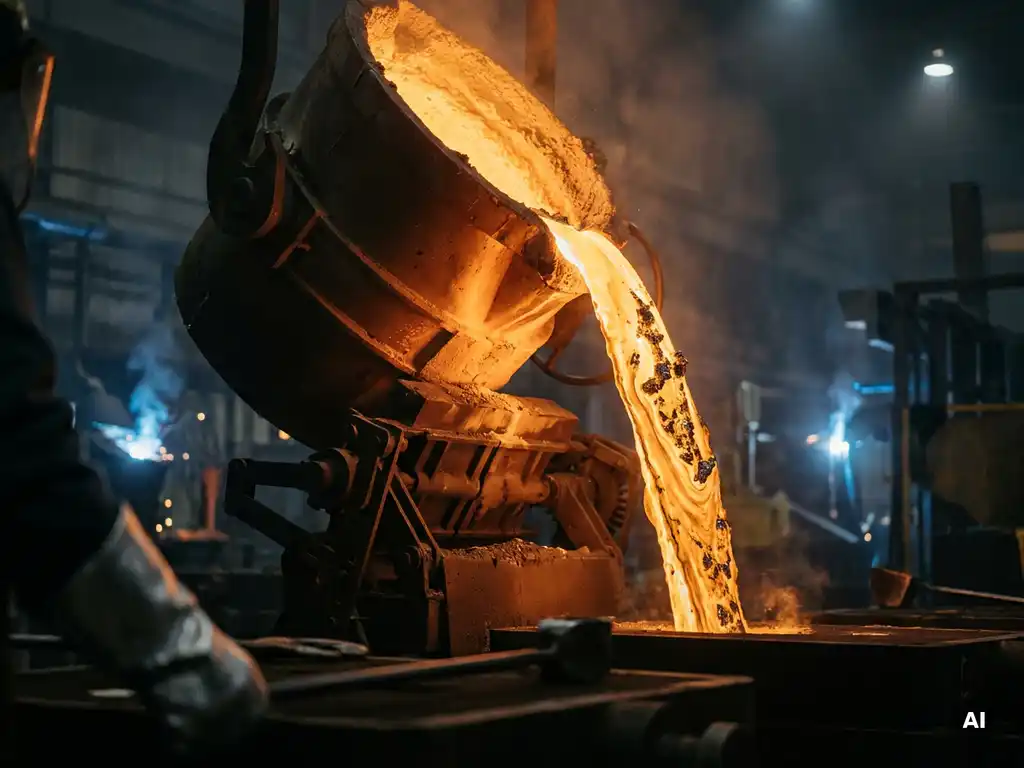
Steelmakers control sulfide inclusion morphology during casting primarily through calcium treatment of the liquid steel, combined with precise management of steel chemistry, particularly sulfur, oxygen, and aluminum content. By modifying the thermodynamic conditions in the melt before and during casting, metallurgists can shift sulfide inclusions from harmful elongated forms into more benign globular shapes. The sections below address the key questions that guide this process in practice.
What causes sulfide inclusions to form during steel casting?
Sulfide inclusions form because sulfur has limited solubility in solid steel compared to liquid steel. As the melt solidifies during casting, sulfur is rejected from the solidifying front and combines with elements such as manganese, iron, or calcium to form solid sulfide compounds. These compounds precipitate within the steel matrix, creating inclusions whose size, shape, and distribution depend heavily on steel chemistry and solidification conditions.
The primary driver is the sulfur content of the steel, but sulfur alone does not determine the outcome. The ratio of sulfur to oxygen, the presence of deoxidizing elements such as aluminum, and the concentration of calcium or rare earth metals all influence which sulfide phases form and how they distribute through the solidifying structure. In high-oxygen melts, manganese sulfide (MnS) tends to dominate. In well-deoxidized, aluminum-killed steels, the situation changes significantly because oxygen activity is suppressed, which alters the thermodynamic stability of competing inclusion phases.
Solidification rate also plays a role. Faster cooling, as occurs in continuous casting, limits the time available for sulfide precipitation and can produce finer, more dispersed inclusions. Slower solidification, as in ingot casting, allows more time for coarser sulfide phases to develop and segregate.
What are the different types of sulfide inclusion morphology?
Sulfide inclusions in steel are conventionally classified into three morphological types, each with distinct formation conditions and consequences for mechanical properties. Type I inclusions are globular and form in steels with relatively high oxygen content. Type II inclusions are elongated films that form at grain boundaries during solidification and are generally the most damaging. Type III inclusions are angular or irregular and typically appear in fully deoxidized steels.
The classification matters because inclusion shape directly affects how stress concentrates around the inclusion during mechanical loading. Elongated Type II sulfides act as notches within the steel microstructure, reducing ductility and toughness in the transverse direction. This is particularly problematic in steels used for pressure vessels, pipelines, or structural applications where through-thickness properties are critical.
Globular inclusions, whether naturally occurring Type I or artificially induced through calcium treatment, are far less damaging because they present a lower stress concentration factor and do not form continuous films along grain boundaries. The goal of sulfide morphology control in clean steel production is therefore to suppress Type II formation and promote a globular inclusion population.
How does calcium treatment change sulfide inclusion shape?
Calcium treatment converts elongated manganese sulfide inclusions into globular calcium sulfide or calcium-aluminate-sulfide complexes by replacing manganese with calcium in the sulfide phase. Because calcium has a much higher affinity for sulfur than manganese under the thermodynamic conditions present in aluminum-killed liquid steel, it effectively modifies the inclusion composition and, consequently, its morphology during solidification.
The treatment is typically applied by injecting calcium in wire or powder form into the ladle after secondary metallurgy refining. The key is achieving the correct calcium-to-sulfur ratio in the melt. Insufficient calcium leaves residual MnS that can still form Type II morphologies. Excess calcium can produce high-melting-point calcium aluminates that clog submerged entry nozzles during continuous casting, creating a different quality and operational problem.
Effective calcium treatment therefore requires tight control of both the sulfur content before treatment and the dissolved oxygen and aluminum levels in the melt. The treatment works best in steels that are already well deoxidized, because a low oxygen activity allows calcium to act primarily on sulfur rather than being consumed by oxide formation. When the chemistry window is correctly managed, calcium treatment reliably produces a globular inclusion population that survives the mechanical deformation of rolling and forging without elongating into harmful stringers.
How does the ladle sliding gate affect inclusion behavior during casting?
The ladle sliding gate controls the flow of liquid steel from the ladle into the tundish, and its design and operation have a direct influence on inclusion behavior during casting. Turbulent or uncontrolled flow through the gate can generate reoxidation, promote slag entrainment, and create conditions that introduce new inclusions into the steel stream after all ladle metallurgy refining has been completed.
Reoxidation at the ladle outlet is one of the most common sources of late-stage inclusion generation in clean steel production. When liquid steel contacts atmospheric oxygen during transfer, it forms fresh oxide inclusions that can interact with existing sulfide populations and alter their morphology and distribution. Minimizing this contact is therefore a fundamental requirement for maintaining the inclusion control achieved during secondary metallurgy.
Inert-gas shielding at the ladle slide gate helps reduce the exposure of the steel stream to oxygen during casting. Systems designed to support clean steel production incorporate provisions for inert-gas application in the vicinity of the gate, helping to displace oxygen from the steel stream without requiring modifications to the broader casting line. Consistent gate operation also matters: flow interruptions, partial gate openings, or gate wear that creates turbulence can all introduce conditions that undo the careful inclusion engineering performed in the ladle.
What steel chemistry parameters control sulfide morphology most effectively?
The four chemistry parameters that most directly control sulfide inclusion morphology are sulfur content, dissolved oxygen activity, aluminum content, and calcium content. Managing the relationships between these four variables, rather than any single parameter in isolation, is what gives metallurgists reliable control over inclusion shape.
Sulfur content sets the baseline. Lower sulfur reduces the total volume of sulfide inclusions that can form, which in turn reduces the risk of harmful morphologies. Most clean steel specifications target sulfur levels well below 0.010%, and many demanding applications require levels below 0.005%.
Dissolved oxygen activity determines which inclusion phases are thermodynamically stable. In high-oxygen melts, MnS dominates and tends to form the elongated Type II morphology. Deoxidation with aluminum suppresses oxygen activity and shifts the equilibrium toward inclusion types that are more amenable to calcium modification.
Aluminum content, once sufficient for full deoxidation, also influences the formation of alumina inclusions that can serve as nucleation sites for sulfide precipitation. The balance between aluminum and calcium must be managed to avoid producing high-melting-point calcium aluminates.
Calcium content, expressed as the calcium-to-sulfur ratio or the calcium-to-aluminum ratio in the melt, determines whether the calcium treatment achieves full sulfide modification. Industry experience consistently shows that hitting the correct chemistry window for all four parameters simultaneously is the most reliable path to a globular inclusion population.
How do steelmakers verify sulfide morphology after casting?
Steelmakers verify sulfide inclusion morphology through metallographic examination of samples taken from cast products. The standard approach involves preparing polished cross-sections from representative locations in the cast strand or ingot, then examining them under optical microscopy or scanning electron microscopy to characterize inclusion size, shape, distribution, and composition.
Optical microscopy allows rapid assessment of inclusion morphology across large sample areas and is used routinely in production quality control. Automated image analysis systems can quantify inclusion populations statistically, providing data on the proportion of globular versus elongated inclusions and their size distribution. This quantitative approach is more reliable than visual rating alone, particularly when comparing heats or evaluating the effect of process changes.
Scanning electron microscopy combined with energy-dispersive X-ray spectroscopy (SEM-EDS) provides compositional information that allows the inclusion type to be confirmed. This is particularly useful for verifying whether calcium treatment has successfully converted MnS inclusions into calcium sulfide or calcium-aluminate-sulfide complexes, since morphology alone can sometimes be ambiguous.
Cleanliness standards such as ASTM E45 and DIN 50602 provide standardized rating methods for inclusion assessment, and many steel specifications reference these standards directly. For demanding applications, steelmakers may also use ultrasonic testing to detect larger inclusion clusters that could affect product performance, complementing the microscopic examination of polished samples.
How KNÖLLINGER FLO-TEC supports inclusion control during casting
We design and manufacture ladle slide gate systems specifically for steelworks that take clean steel production seriously. Our systems are built to support the kind of controlled, consistent casting conditions that sulfide morphology management depends on. Here is what we bring to the process:
- Inert-gas shielding capability: Our GT-series slide gates can be flooded with inert gas such as argon, helping to reduce reoxidation at the ladle outlet and protect the inclusion cleanliness achieved during secondary metallurgy.
- Robust, reliable gate operation: Consistent flow control through the ladle outlet reduces turbulence and slag entrainment, both of which can introduce new inclusions into the steel stream during casting.
- Enclosed design for operational safety: The system design helps contain steel in the event of a leak, supporting safe operation during the critical casting phase.
- Compatibility with patent-free refractory plate formats: Our systems can be adapted to work with different refractory plate formats, giving steelworks flexibility in their refractory sourcing and reducing dependence on a single supplier.
- Customized solutions: We develop gate systems to match specific ladle sizes and operating requirements, so the solution fits your process rather than the other way around.
If you want to discuss how our slide gate systems can support your clean steel targets, contact our team directly. You can also explore our product range or download technical documentation to review our systems in more detail.